
Two Sides of Japan’s Immigration Policy: Welcoming Migrant Workers and Excluding Asylum Seekers
Despite a new immigration system to address labor shortages, the Japanese government remains reluctant to address undocumented migrants, specifically Karihomensha communities. This article explains how the unethical treatment of undocumented migrants in Japan reflects a broader issue in which the country fails to protect the human rights of migrant workers who contribute to critical economic growth. It argues that, to remedy this human rights crisis and adhere to national and international standards, Japan should grant undocumented migrants residence status and proposes a mechanism to do so.
In June 2023, the Japanese Parliament (Diet) passed a controversial amendment to the Immigration Control Act, establishing stricter regulations for asylum seekers and increasing enforcement for deportations. Japan’s Ministry of Justice has argued that the bill was necessary to address “concerns of system misuse.” However, critics have pointed out that the revisions fail to adhere to international humanitarian law on the rights of asylum seekers and the treatment of undocumented migrants. This new legislation reflects a broader issue in Japan: the country desperately needs migrant workers for its economic growth, but refuses to enact policies to protect the human rights of foreigners. The government’s treatment of undocumented people is perhaps the most blatant example of this contradiction.
Overview Of Japan’s Immigration Policy
Japan’s economic boom of the late 1980s and early 1990s first created demand for cheap and flexible labor. In response, undocumented immigrant workers entered the country on short-term visas to fill this gap and subsequently overstayed to continue working. The influx of undocumented migrants slowed between the 1990s and 2000s as Japan sought to shift away from short-term visas. To that end, the government enacted the Immigration Control Act, the main immigration statute in Japan, to instead attract technical intern trainees—understood as temporary workers brought under international cooperation efforts and the “side-door policy”—and Latin American Japanese descendants. The number of undocumented migrants increased again to meet the demand for construction workers after the 2011 earthquake and tsunami, and for the 2020 Tokyo Olympic Games. Across the various contexts of the preceding four decades, Japan has consistently relied on undocumented migrant workers to fill the gaps in its domestic labor force.
Despite the need for migrant labor, however, the government has continually implemented strict border policing and restrictive policies for undocumented migrants. To change a work-based residence status to permanent residency status, regularization regulations require marriage to a Japanese national or five or more years of regular employment, exclusive of trainees. Although some undocumented migrants have achieved such status, the regularization of undocumented migrants relies on administrative discretion and has become increasingly rare. In the early 2000s, 10,000 people were regularized per year; since 2016, the government has regularized only a tenth of that number. Additionally, although many undocumented migrants are refugees, Japan’s refugee recognition rate has remained low. Since ratifying the Refugee Convention in 2022, the average refugee recognition rate has been 1.4 percent. As a result, few have been motivated to apply for refugee status, despite qualifying by international and national standards. Instead, they get lost in the system and become “undocumented migrants.”
In considering an applicant’s eligibility for regularization, the Ministry of Justice considers “the degree of integration into Japanese society.” Although most migrants act as “model” citizens to demonstrate their “integration,” Japan’s emphasis on social order, coupled with embedded racism, has left many migrants ostracized and with little prospect of regularization. For undocumented migrants who overstayed their visas, there are no systems in place to promote their social integration or protect their human rights, and they risk detainment and forced deportations.
Prolonged Immigration Detention Period
As of 2025, 71,229 migrants remain undocumented. When discovered, undocumented migrants are detained until they accept deportation. The author’s investigative interviews revealed that some undocumented migrants have been detained for more than eight years, with one Sri Lankan woman dying during her detention because she was refused care. The prolonged detention period led to hunger strikes by 235 detainees in 2019, after which the Immigration Services Agency acknowledged that long-term detention was a problem. For this reason, the Immigration Policy Advisory Committee decided to establish a special subcommittee to solve the problem of the prolonged detention of undocumented migrants who refuse repatriation. Said Committee proposed the aforementioned amendment to the Immigration Control Act in 2019/2020.
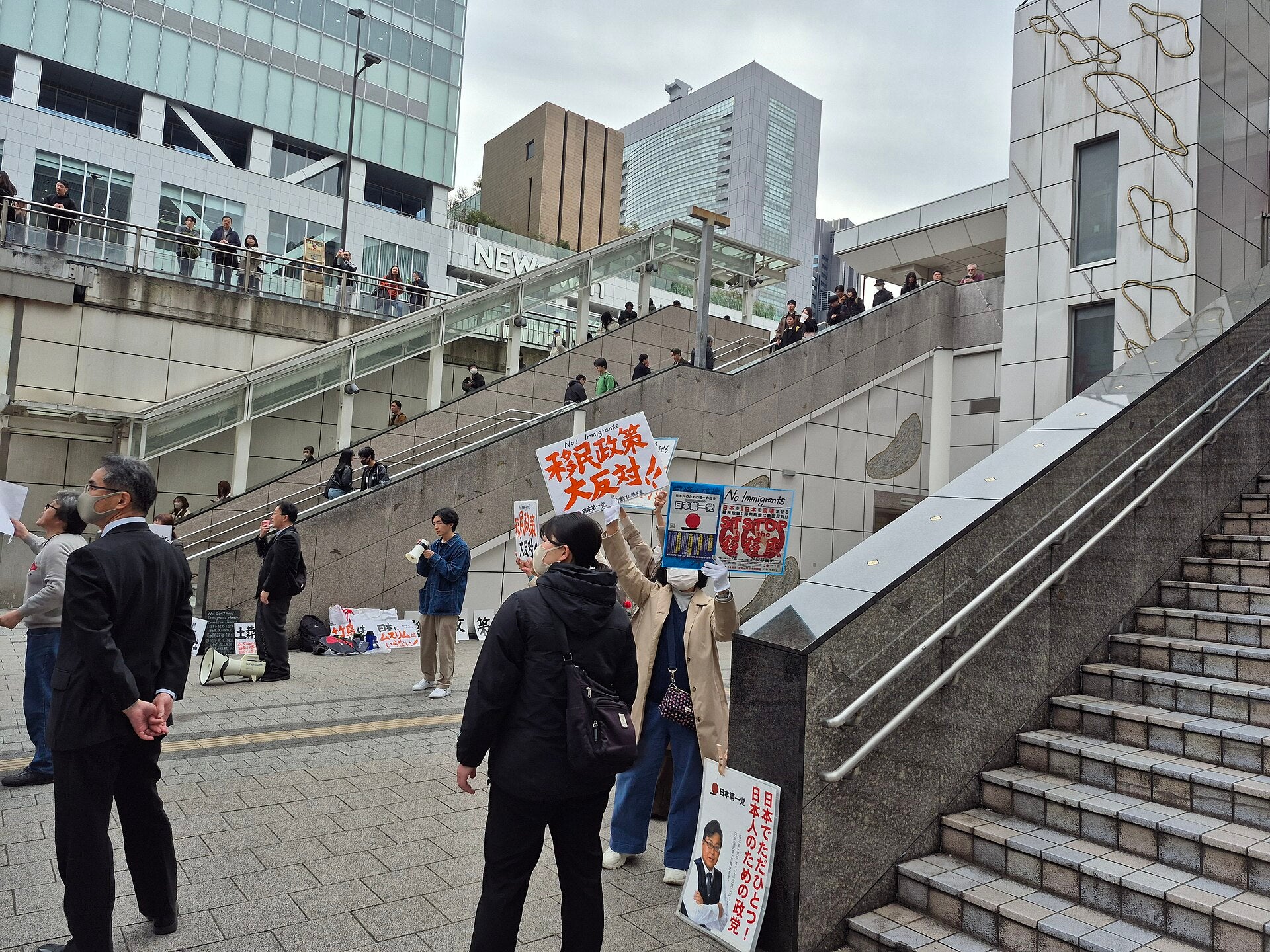
Although it was intended to solve the problem of long-term detention, the Immigration Control Act Amendment Bill contained proposals that do not meet international human rights standards, including capping refugee applications to two times per individual and facilitating the deportations of detained migrants. Advocacy and support groups for migrants’ rights campaigned against the bill throughout March 2021, demonstrating opposition through standing and sit-in protests in front of the Diet. For many individual migrants, these protests constituted the first time they made their voices heard. Despite backlash, however, the Diet adopted the bill in June 2023.
The pushback against the Immigration Control Act Amendment Bill was perhaps the strongest social movement in Japan to rally against the blatant violations of the human rights of foreigners. While opposition to the reforms was ultimately unsuccessful, it has called attention to the problems embedded in Japan’s current approach to immigration and the status of foreigners.
Karihomensha: Impossible to return, impossible to stay
If arrested, undocumented migrants are, in principle, detained in immigration facilities until they accept deportation. Many opt to return to their home countries to avoid prolonged detention. However, some refugees do not have that luxury. As the capacity of the detention centers is limited, undocumented migrants are frequently provisionally released from detention and authorized to live in the local community as Karihomensha.
Although in 2023, there were as many as 4,133 Karihomensha, theydo not represent the general population of undocumented migrants. The chief nationalities of Karihomensha are Turkish and Kurdish (579), Iranian (276), Sri Lankan (227), Pakistani (180), Nigerian (141).
Before becoming Karihomensha, most people were employed by Japanese companies facing labor shortages. According to government statistics, from 2003 through 2025, more than 75 percent of undocumented migrants had been working when they were arrested. In particular, Kurds, the largest group in Karihomensha, have become self-employed as business owners in the demolition sector of the construction industry, where labor shortages are severe. However, once they become Karihomensha, they are prohibited from seeking employment as well as services from most public social assistance systems, including emergency medical care.
Despite their original and potential future contributions to the labor force, the author’s interviews revealed that Karihomensha are shut out at government offices as “people who should not exist” when they attempt to exercise their social rights. The government bases its framework and treatment on the so-called McLean case, a 1978 Supreme Court decision that ruled that basic constitutional human rights are only guaranteed for foreigners within the framework of Japan’s residence status system.
The UN Human Rights Committee has pointed out the human rights violations against Karihomensha by the Japanese government and asked for the implementation of a comprehensive migrant protection law that respects international standards. It has also asked for consideration of measures to ensure that Karihomensha could earn a living. In response to these comments, the Minister of Justice announced a plan to regularize children born and educated in Japan, claiming that “children are not responsible.” However, only 212 Karihomensha were regularized using this measure, and it has not been used since. Many children who have come to Japan with their families subsequently remain undocumented.
At the time that the author conducted interviews, some Karihomensha had been living in the local community for upwards of 30 years. Their children receive education in Japan and often do not even understand the languages of their origin, aspiring to pursue higher education and find employment in Japan. They have spent most of their lives in Japan, and all their bases of life, including their relationships, no longer exist in their country of origin. Returning “home” is not an option.
Japan’s Refusal to Reckon with the Karihomensha
Why does Japan’s immigration policy fail to align with modern human rights standards? This is partly due to Japan’s adoption of strict jus sanguinis principles: a person acquires nationality based on their parents’ nationality. Rather than confronting the reality of a labor shortage, the Japanese government has implemented immigration policies based on a xenophobic ideology that views the growing number of foreigners as a threat, as a result of centuries of a strict social order that viewed the Japanese as a superior race and every other race as inferior. Today, Japan continues to tighten the requirements for foreigners to obtain nationality or permanent residency, aiming to prevent their settlement in Japanese society entirely.
Xenophobic immigration policy is most clear in the employment policy. Because Karihomensha are prohibited from seeking employment, they are deprived of the means to make a living. Their lives become completely dependent on others, and they cannot survive without receiving aid from humanitarian organizations and religious groups. Unable to find employment, Karihomensha find themselves in a broken cycle: the same system that demands they prove their “integration” into society prohibits them from doing so. They are unable to become regularized, with more barriers arising every year they spend as Karihomensha. Many Karihomensha thus describe their provisional release as “a prison without bars.”
Migrants came to Japan in the first place to fill in significant labor gaps. Yet, despite Japanese policies’ attempts to find long-term solutions, the domestic labor shortage for large projects, such as the Olympic Games, persists. Migrants continue to fill this gap. As such, they are critical to Japan’s functioning society and economic growth; refusing to reckon with Karihomensha is not just a human rights violation but a significant economic loss.
Policy Recommendations
Based on the Japanese government’s own guidelines that expect social integration, many Karihomensha should be regularized. However, regularization remains at the discretion of the administration, and the guidelines are only used as a reference.
To remedy a pervasive human rights crisis, the Japanese government must establish transparent and standardized criteria for the regularization of undocumented migrants. For example, the government could introduce a Japanese equivalent of the Deferred Action for Childhood Arrivals (DACA), targeting parents and their children who arrived in Japan at a young age. Through such reform, children who either a) attended Japanese schools for five consecutive years between elementary school and high school, or b) graduated from a Japanese high school, and have been accepted into a vocational school or university would be regularized along with their parents. By clarifying the criteria for regularization, families with no chance of regularization could decide whether to return home. If regularization is left to the discretion of immigration authorities, they will cling to hope and be unable to make that decision. However, this measure has the drawback of tolerating human rights violations during the period until they are integrated into Japanese society.
Conclusion
The government must recognize that Japan needs migrant workers for its own economic growth and that foreigners are entitled to basic human rights and dignity. For several years in the early 2000s, the Japanese government was regularizing approximately 10,000 undocumented migrants per year who had integrated into society at its discretion, so it should be able to do the same today. To do so, Japan should establish a system that respects human rights regardless of immigration status and prevent further serious losses, both pragmatically and humanely, before it is too late.
. . .
Nanako Inaba is a professor of sociology at Sophia University. She is also a board member of Solidarity Network with Migrants Japan.
Image Credit: Whoisjohngalt, CC0 1.0 Universal, via Wikimedia Commons
