
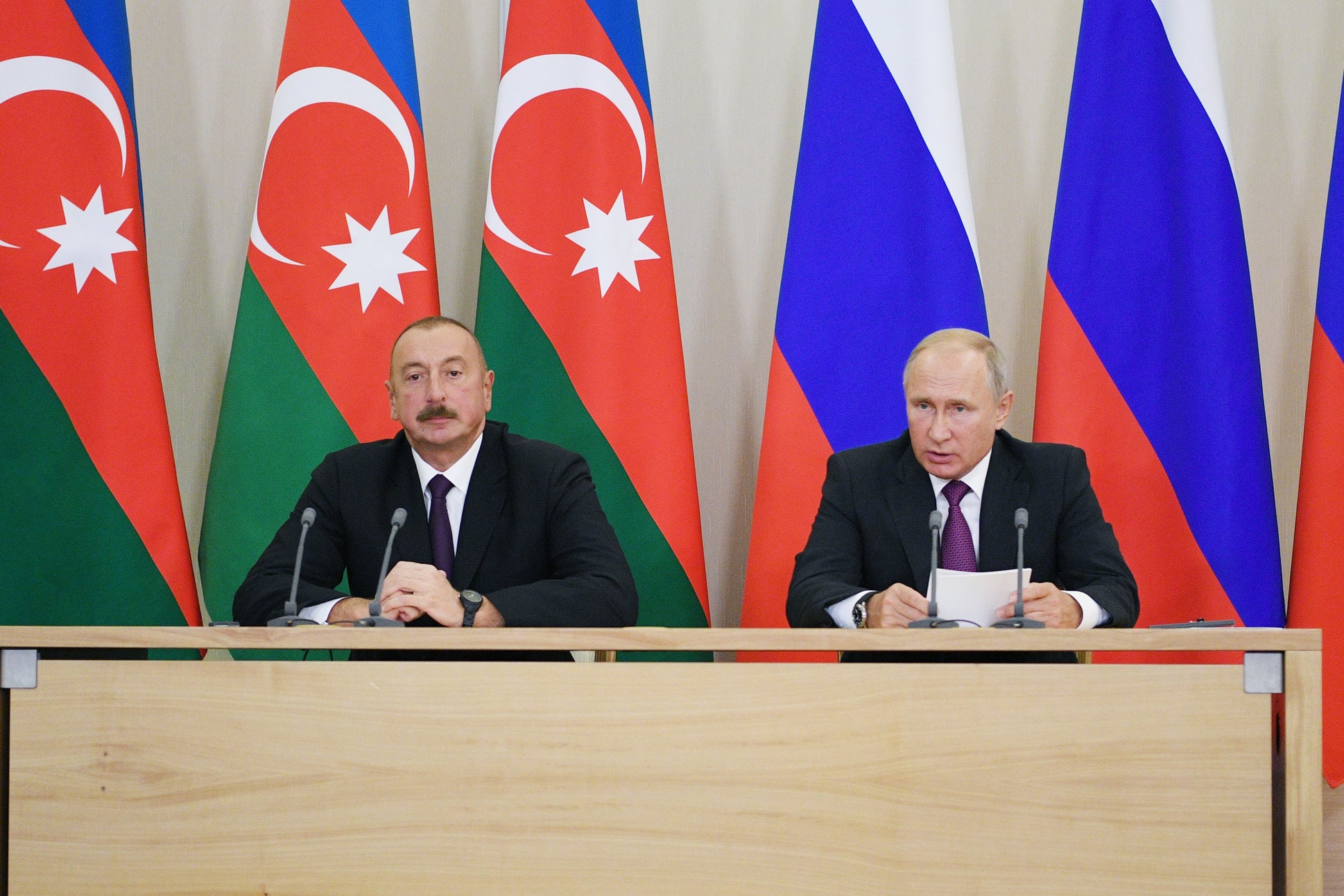
Azerbaijan’s Northern Question: How the War in Ukraine Has Changed Relations Between Azerbaijan and Russia
Russia’s actions and lack of action in Georgia in 2008, Ukraine in 2014, the 2020 Nagorno-Karabakh war, and the 2022 full-scale invasion of Ukraine have reshaped its relationship with Azerbaijan. While Azerbaijan previously managed two separate relationships with Russia, it has come into its own further since 2020, and the country should continue to do so.
Introduction
For Azerbaijan, there is not one Russia but two: Russia, the Neighbor, and Russia, the Hegemon. Azerbaijan has long built its foreign policy architecture around balancing these two contradictory perceptions. Russia, the Neighbor, offers tangible benefits, from economic dividends to labor mobility. However, Azerbaijan perceives Russia the Hegemon as an existential threat that still yearns for its yoke after a century of colonial rule. Azerbaijani perceptions of Russia are never settled; they are constantly renegotiated.
Two Russias can coexist in an uneasy equilibrium until crisis intervenes. Chains of shocks trigger a collapse, such as the downing of an Azerbaijani passenger plane over the North Caucasus in December 2024 that killed 38 people, the arrest of Azerbaijani diaspora leaders in June 2025 Russia, and Baku’s subsequent closure of Russian media outlets. While the immediate crisis matters, what matters more are its impacts: a recalibration of how much risk Azerbaijan is prepared to absorb in its relationship with Moscow. Azerbaijan must adopt compartmentalized pragmatism, maintaining a posture that remains legible to its partners in the post-Soviet, and increasingly post-Western, space.
Rising Russia and Azerbaijan
Russia’s war with Georgia in 2008 and Ukraine in 2014 reshaped the post-Soviet landscape drastically. Western organizations, such as NATO and the EU, met both with a limited response, which crystallized two meta-dynamics: first, Western normative power remained effectively confined to NATO’s geographic perimeters, beyond which commitments carried limited coercive weight; and second, Georgia’s and Ukraine’s pro-EU and NATO choices, which were made on the assumption that alignment would yield security guarantees, proved to be miscalculated.
Azerbaijan learned a strategic lesson to avoid overreliance on NATO and the EU, particularly after the annexation of Crimea in 2014. Moscow’s coercive ceiling had risen, and misreading it carried tangible costs. Confronted with an ascending regional power on its immediate perimeter, Baku adjusted accordingly, opting for accommodation in line with the pure realpolitik logic that has long guided small-state behavior under asymmetric power conditions.
For more than a decade after the 2008 war, Azerbaijan expanded cooperation with Russia where possible, such as in defense procurement and joint economic projects. Russian weapons accounted for roughly 60 percent of Azerbaijan’s major arms imports between 2011 and 2020 — sophisticated weapon systems, artillery systems, air defense missiles — an arsenal that materially shaped the operational balance Baku carried into the Second Karabakh War. In parallel, the North–South International Transport Corridor embedded Azerbaijan in a logistics architecture stretching from the Baltic to the Indian Ocean, a project that has persisted through the post-2022 turbulence and continues to generate the kind of low-political, high-economic dividends that make total disengagement not fully desirable.
Post-War Russian Order in the South Caucasus: Rise and Fall
The apex point of understanding Russia, the Hegemon, was the Second Karabakh. In November 2020, Russian peacekeeper convoys entered the serpentine Lachin corridor to secure the frontline in Nagorno-Karabakh – a disputed region internationally recognized as part of Azerbaijan and the site of a six-week war between Armenia and Azerbaijan in the early 1990s. A consensus quickly formed that Russia was the strategic victor. Azerbaijan was not “permitted” to declare a full victory, whereas Armenia was not fully defeated. Both found themselves embedded in a new post-war architecture whose chief architect was President Vladimir Putin.
The Nagorno-Karabakh deal of 2020 was Russia’s most notable diplomatic intervention since the end of the Cold War. Russia stopped a war in the periphery, stationed troops, absorbed negotiations into a Russian-managed framework. Russia reasserted itself as an ordering power, exercising agenda-setting authority over the diplomatic process and the security architecture it produced.
Then came February 2022. Russia’s invasion of Ukraine forced a drastic recalculation in both Baku and Yerevan. What had been a carefully managed asymmetry between Armenia and Azerbaijan, arbitrated from above by Moscow, suddenly became a liability for Russia and a concern for its periphery. Sustaining that arbitration required spare diplomatic bandwidth, military deployments, and political attention – precisely the resources Ukraine was now consuming – and as Moscow’s capacity contracted, Baku and Yerevan each concluded that the post-2020 architecture had become too costly to sustain on Russia’s terms. Azerbaijan swiftly moved to dismantle President Putin’s Nagorno-Karabakh dealand remove the Russian presence from the enclave.
The 2020 trilateral Armenia-Azerbaijan-Russia deal collapsed quickly. Russia planned for the deal to last for decades, but by the summer of 2024, just four years after its signature, Russian military convoys withdrew from Nagorno-Karabakh. A year later, in August 2025, Armenia and Azerbaijan signed a United States-facilitated agreement that paved the way for a U.S. role in the space that, five years earlier, had been stipulated to host Russian troops. The reversal of what once looked like a durable Russia-led post-war order was rapid; it revealed that Russia’s posture had become thinner than it appeared.
Today, Russia is no longer central to the Armenia–Azerbaijan peace process. This outcome has not been produced solely by Baku’s or Yerevan’s mastery of diplomacy. Evident in Russia’s withdrawal of its convoys from Nagorno-Karabakh, Russian disengagement has also largely been a consequence of Moscow’s own political choices and constraints.
The War in Ukraine
The war in Ukraine has paradoxically strengthened Russia’s military-security bloc. Through external projection and political leverage, the siloviki increasingly collide with the risk-averse preferences of Russia’s economic technocrats, who manage the trade portfolios that keep the wartime economy afloat. Hence, the friction with Azerbaijan is not only bilateral but symptomatic of intra-elite competition, as rival factions seek to shape Russia’s post-2022 foreign policy orientation. For the security bloc, coercive signaling against an assertive Baku affirms Russia’s residual primacy in the near abroad; for the technocrats, it threatens precisely the trade, transit, and labor-mobility channels through Azerbaijan that have grown indispensable for the post-2022 Russia.
The direction of the Russia-Azerbaijan relationship largely rests on President Vladimir Putin. Recent signals demonstrate the Russian strategy of calibrated pressure on Azerbaijan without institutionalized confrontation. Conciliatory gestures, such as the apology following the December 2024 aircraft incident, have been offset by quieter reassurances, including intelligence-sharing on alleged coup plots. Russia remains focused on Ukraine, with exit options diminishing. Even as the war loses strategic coherence, it now serves a different function: sustaining intra-elite balance and legitimizing the political order. The fighting keeps the siloviki empowered and ideologically vindicated while binding the technocrats to a permanent posture of crisis management which makes them indispensable but politically subordinate, with neither faction able to challenge the arbiter while the war continues to supply the narrative justification for the wartime state itself. In Azerbaijan, Russia’s distraction is read as a window for unprecedented agency. But it is a window with constraints: interdependencies remain, and Moscow’s capacity for episodic disruption has not vanished.
The war in Ukraine has recast the architecture within which Azerbaijan’s “Northern Question” operates. The dual image of Russia as Neighbor and Hegemon has not disappeared, but the equilibrium between the two has shifted. As Russia continues its war in Ukraine, the country looks more self-absorbed, less able to sustain both roles at once. In Baku’s reading, Russia the Neighbor remains available for selective cooperation, while Russia the Hegemon has lost part of its material leverage. Yet this is not an open invitation for confrontation. The size of the Azerbaijani diaspora in Russia and the embeddedness of economic and logistical ties remain powerful disincentives to escalation. Even as rhetoric hardens, structural incentives still pull toward calculated cooperation.
Azerbaijan’s Post-Russia Moment
Several factors explain Azerbaijan’s shifting relationship with Russia. They deserve to be named as deeper structural movements: first, anti-colonial discourse is being absorbed into Azerbaijan’s evolving national identity architecture, cementing Russia’s role as a referential “Other” in the process of self-definition; second, in coordination with Türkiye, Azerbaijan has begun to test an aspiration to play a shaping role across a wider inner Eurasian belt, from the South Caucasus to Central Asia, where Russia’s exit is increasingly observable; and third, Baku is widening its diplomatic outreach to reduce dependency on any single axis, including by probing new channels with Washington.
The first process is already visible. As Azerbaijan enters a post-conflict period with Armenia, Karabakh is no longer the gravitational core of national legitimacy. In its place, a new pillar appears to be taking shape: anti-colonialism. Coverage during the crisis was saturated with references to historical injustice. This tapped into national narratives that cast Russia, the Hegemon, as the grand architect of national setbacks, conflict, and underdevelopment.
The second meta-process, Azerbaijan’s widening regional horizon, also warrants a deeper analysis. The erosion of Russia’s convening role across the South Caucasus and Central Asia has not produced a coherent successor order, but a patchwork of openings. Baku has begun acting less as a transit point in this geography and more as its aggregator: brokering the Caspian green energy cable that channels Central Asian renewable output toward Europe through Azerbaijani territory, partnering with the State Oil Company of the Republic of Azerbaijan (SOCAR) and KazMunayGas on swap arrangements that route Kazakh crude through Baku-Tbilisi-Ceyhan, and accelerating institutionalization of Turkic-state coordination. Moscow remains structurally embedded in regional security and economic networks, particularly in Central Asia. The space for cross-regional interaction is therefore fragmented and provisional, shaped as much by risk-aversion as by opportunity.
The third process is the most consequential and the least settled: Azerbaijan’s search for a post–post-Soviet orientation, including exploratory outreach to Washington. The U.S.-facilitated Armenia–Azerbaijan agreement served not only to address a connectivity dispute, but to test whether a bilateral channel with the United States could yield concrete diplomatic or security returns. Although Baku appears to have secured high-level interest in the White House, translating presidential attention into sustained institutional engagement would be premature.
Azerbaijan between Post-Russian and Post-Western: A Way Forward?
Azerbaijan’s relations with Russia should not be reduced to a binary choice. It is a matter of managing asymmetry where interests still overlap and constraints endure. The task for Baku should be selective disengagement, limiting Russia’s role where it constrains sovereignty, while keeping open channels where cooperation remains useful. Trade, transport, energy logistics, and labor mobility fall into this latter category.
Managed asymmetry reaches beyond the northern frontier. Azerbaijan’s broader regional and extra-regional engagement is best seen as an effort to spread risk in a more uncertain environment. Differentiation is essential: Türkiye remains Azerbaijan’s core political and security partner, where interests and threat perceptions converge most clearly. China is likely to remain a transactional partner, focused on infrastructure, trade, and logistics rather than security. But Azerbaijan should also prepare for a more diffuse post-Western order in which cooperation patterns are increasingly situational and arena-specific. The European Union provides economic depth and access to markets, even if its strategic engagement remains uneven. The United States is best approached selectively, with modest expectations and a preference for institutional channels over personalized diplomacy.
This political context leads to a policy of compartmentalized pragmatism. Rivalry and cooperation do not have to be mutually exclusive, nor must they be made to fit a single overarching logic. Such an approach neither accepts hierarchy nor locks Azerbaijan into fixed alignments. It reflects a more modest reading of the emerging order, one in which strategic value depends less on bloc affiliation than on context. For Azerbaijan, the task is to maintain a posture that remains legible to multiple partners while preserving the ability to adjust as the post-Soviet, and increasingly post-Western, space continues to evolve.
In the long-term, Azerbaijan’s Northern Question can no longer be understood as a problem defined by Russia alone. Moscow still looms large in Azerbaijani thinking, as both Neighbor and Hegemon, but in a diminished and more inward-looking form. Russia today is less able to impose a comprehensive regional order than at any point since the early post-Soviet years. Yet it remains capable of episodic coercion and selective disruption. The challenge is no longer how to balance against an overbearing hegemon, but how to turn short-term flexibility into a durable posture without locking Azerbaijan into a new cycle of rivalry.
. . .
Shujaat Ahmadzada is an independent researcher focusing on the South Caucasus, Eastern Europe, and Central Asia.
Image Credit: President.az, CC BY 4.0, via Wikimedia Commons
