
Iceland: A View from the Bridge
A founding member of the North Atlantic Treaty Organization (NATO), Iceland had reasonably secure national defenses after World War II, even after the unilateral withdrawal of U.S. forces from Iceland in 2006. Yet since 2022, Russia’s war of aggression against Ukraine coupled with waning American commitment to NATO has altered the landscape of Icelandic security. Therefore, to bolster its defenses and its democracy, Iceland may find it necessary, as well as desirable, also for economic reasons, to join the European Union.
On the Bridge Between Europe and America
Geographically as well as culturally, Iceland is a close ally of both the U.S. and Europe. The country has been a NATO member since 1949. Iceland is also a member of both the European Free Trade Association (EFTA) and the European Economic Area (EEA) since 1970 and 1994, respectively, amounting to a “light” membership of the European Union (EU). This means that Iceland accepts many of the economic benefits and legal obligations of EU membership—including the free movement of goods, services, people, and capital among member states. However, Iceland is not obliged to adopt the euro, nor does it participate in the EU’s common agricultural, fisheries, foreign, and security policies, trade agreements with third countries, or tax coordination. It also has no say in EU legislation.
From the early 1990s, opinion polls in Iceland showed a small but consistent majority of respondents in favor of EU membership. This changed after the financial crash of 2008, when the politicians mostly responsible for the crisis at home deflected blame on foreign parties, including the EU. Politicians, mainly from the Independence Party and the Progressive Party, who had aided the failed—and jailed—bankers, temporarily managed to sway public opinion against EU membership. But this shift did not last.
In 2010, the Special Investigation Commission, appointed by Parliament, declared the Prime Minister, two other ministers, the three Central Bank governors, and the director of the Financial Supervisory Authority guilty of negligence by law. Shortly thereafter, Parliament resolved unanimously that “criticism of Iceland’s political culture must be taken seriously and [parliament] stresses the need for lessons to be learned from it. Parliament resolves that the report of the Special Investigation Commission of the parliament constitutes a condemnation of the government, politicians, and public administration.”
Shortly after the 2008 crash, in which foreign creditors as well as domestic firms and families took huge losses, a new Icelandic Parliament, convinced that the benefits would outweigh the costs, applied for EU membership in 2009. Negotiations commenced. The application could be seen as an apology of sorts—a commitment by Iceland to subject itself henceforth to the discipline required by EU membership. The IMF was brought in to mount a rescue operation. Aided by loans provided mostly by other Nordic countries and Poland, Iceland recovered over a healthy period of eight years (see Figure 1 below).
In 2013, with the recovery underway, the political parties primarily responsible for the crash—the Independence Party and the Progressive Party—returned to office. The foreign minister sent a letter to Brussels in 2015 unilaterally declaring the withdrawal of Iceland’s membership application, thinking that a ministerial letter could reverse the 2009 decision by Parliament. The European Commission reacted by quietly removing Iceland from the official list of candidate countries.
In 2025, however, with a new Icelandic government in office (including two pro-EU parties), the EU declared that Iceland would be welcome to resume negotiations at its convenience. Consequently, the new government has now planned a national referendum on the resumption of membership negotiations for August 29, 2026. Recent public opinion polls have shown that majority support for Icelandic membership has been restored. Yet, the key question remains: Why should Iceland join the EU?
Only two of the six political parties currently represented in the Icelandic Parliament favor EU membership, even if the majority of their rank and file supports membership. Many politicians remain beholden to special interests, not least to opposing nouveau riche oligarchs in the fishing industry, a point now conceded by Iceland’s finance minister.
The Prospect of EU Membership: Economics
Since 1960, Iceland has had the OECD’s second highest rate of inflation on average. Adoption of the euro would reduce inflation and lower interest rates in Iceland, making housing affordable again to a young generation currently frozen out of the market. Since the EU is Iceland’s most important trading partner, full membership would eliminate exchange-rate uncertainty, reduce transaction costs, and make Iceland more attractive to foreign investors in start-ups or larger enterprises in energy and even fisheries. Likewise, Icelandic firms would gain full access to the huge European market, including eligibility for financial assistance in times of trouble — as Ireland received in 2008.
The economic arguments against joining the EU revolve mainly around the fear of the EU taking control of Iceland’s marine resources as well as the sacrifice of monetary independence and national sovereignty. However, past experience of EU members debunks the concern about fish. Shared sovereignty, especially concerning monetary affairs in a high-inflation country, is a feature, not a bug. About 74% of people living in an EU member country say that their country benefits from being a member, indicating that sharing sovereignty is not a serious political or economic concern.
Figure 1 shows that the EU experienced a nearly identical average GDP per capita growth rate from 1990 to 2024 compared with Iceland and the U.S. In terms of economic growth, Europe has kept up with the U.S. EU membership need not be a drag on growth, but could instead fortify Iceland’s economy through closer economic integration.
Even if Europe lags behind the U.S. in GDP per capita, Europe outperforms the U.S. in several other respects: Europeans live three years longer on average, they have stronger democracies, greater civil and political rights, more transparency (i.e., less corruption), more equality, stronger rule of law, and more effective mitigation against climate change. This is what attracts many Icelanders increasingly to Europe, even if most Icelanders still favor maintaining friendly relations with the U.S. They see no conflict between the two partnerships, nor should they.
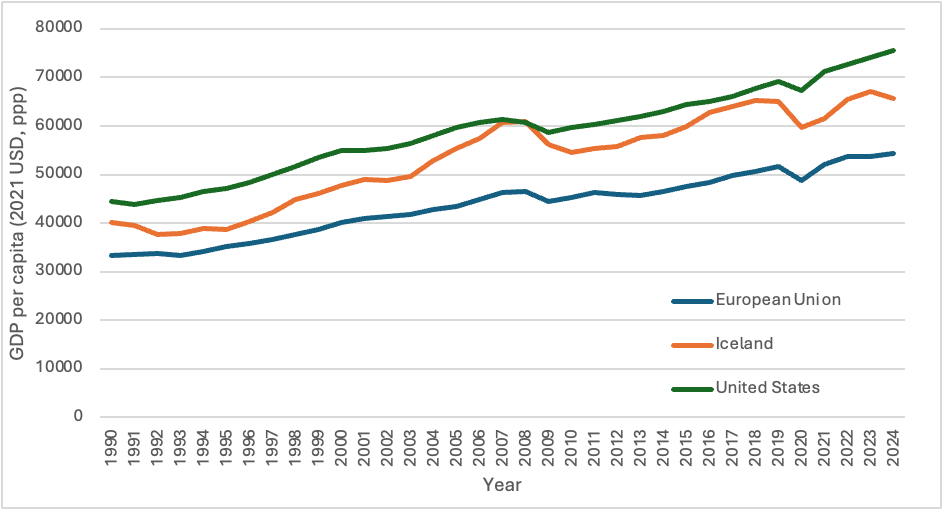
Figure 1. Growth in the GDP per capita of the European Union, Iceland, and the United States (1990-2024)
Source: World Bank Open Data, World Development Indicators
The Prospect of EU Membership: Geopolitics
Beyond economics, there are political arguments for joining the EU: the chance to restructure the security strategy and strengthen financial regulation. First, Russia’s war of aggression against Ukraine has created a new strategic imperative in the region. If Finland and Sweden decided suddenly due to the war to join NATO after 75 years of non-alignment, Iceland should join the EU to strengthen cooperation and security on Europe’s northern frontier. There is safety in shared solidarity. Most importantly, the country’s lack of a standing military has created a military dependence on its NATO allies, especially the U.S. However, the waning U.S. commitment to or even possible withdrawal from NATO, including explicit U.S. designs on Greenland, makes the integration of European defenses especially urgent.
Second, membership would strengthen checks and balances in Iceland’s political and judicial affairs through shared sovereignty. In view of weak local financial supervision, which before the 2008 collapse was dysfunctional by design, Iceland would benefit from the European Central Bank’s banking supervision.
Third, by the principle that guided Iceland to the United Nations in 1946 and NATO in 1949, it is generally prudent to belong to clubs that include most of one’s closest friends and allies, sometimes even regardless of expected benefits and costs.
Democracy, Freedom, and the Rule of Law
Economic considerations alone do not explain Iceland’s changing orientation toward Europe. Institutional and political factors—including democratic governance, civil liberties, and the rule of law—also shape how Icelanders evaluate the benefits of closer integration with the EU.
Iceland’s strategic outlook vis-à-vis Europe and the United States is complicated by the fact that Iceland lags behind the other Nordic countries in several relevant respects—including democratic governance, freedom, and the rule of law—though not in per capita GDP, as shown in Figure 2.
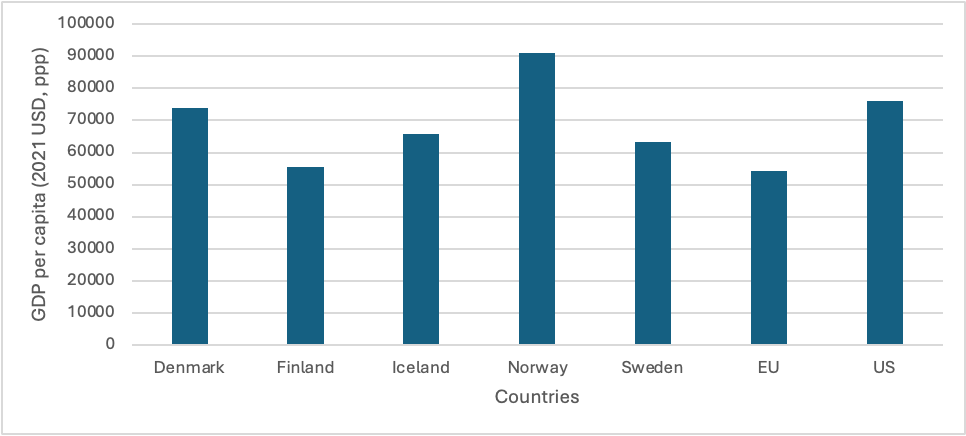
Figure 2. Comparison of the GDP per capita of Denmark, Finland, Iceland, Norway, Sweden, the European Union, and the United States (2024)
Source: World Bank Open Data, World Development Indicators.
Consider the following indices, which seem likely to make EU membership attractive to Icelanders: The 2024 ranking of 179 liberal democracies compiled by the V-Dem Institute at the University of Gothenburg, Sweden, has Denmark in first place, Sweden in fourth, Norway in fifth, Finland in twelfth, and Iceland in 21st place—slightly ahead of the U.S. in 24th place. Also, in its 2025 ranking of freedom in the world, Freedom House awards first place to Finland, third place to Norway, fourth place to Sweden, Denmark sixth, and Iceland 22nd—just behind Germany (21st) but ahead of France (41st) and the U.S. (57th). Finally, according to The World Justice Project, which ranks 143 countries by the strength of their rule of law, Denmark, Norway, Finland, and Sweden are in the top four places in their 2025 global ranking, with the U.S. in 27th place; Iceland is not included.
These comparisons help illuminate Iceland’s rekindled attraction to the rest of Europe and reduced attraction to the United States, for geopolitical as well as economic reasons. If so, even though most of the Icelandic electorate again favors membership, why is it that four of the six political parties represented in Parliament still oppose EU membership? In spring 2025, 44 percent of respondents expressed support for EU membership, while 36 percent expressed opposition and 20 percent were undecided.
Overcoming the Opposition
Although public support for EU membership has rebounded, political resistance remains strong. Who are the main opponents of Iceland’s ascension to the EU? They can, for simplicity, be divided into three overlapping groups.
First, some view EU membership as a serious infringement of national sovereignty and fear having to share Iceland’s fish and energy resources with other EU members. These arguments fly in the face of the experience of existing EU members, who value shared sovereignty and have not seen their natural resources usurped by the EU.
Second, some claim that Iceland’s constitution from 1944 does not permit EU membership, an argument that also applies to Iceland’s EEA membership since 1994. There are valid arguments on both sides of this debate, but the new constitution approved in a national referendum in 2012 but not yet ratified by Parliament explicitly allows EU membership.
Third, there are those who fear losing their long-held privileges—for example, their exclusive access to fishing rights in Icelandic waters. This group includes oligarchs, a small, elite group less in favor of democratic norms, mainly made up of vessel owners enriched by Parliament’s hefty allotment of valuable fishing rights—granted free of charge from the mid-1980s and against only nominal fees since 2002. Even so, marine resources in Icelandic waters are, by law, the common property of the nation. Oligarchs can hardly be convinced to yield; they need to be defeated at the polls.
These entrenched economic interests have implications beyond fisheries policy: they also impede democratic reform and complicate Iceland’s ability to undertake the institutional changes associated with closer European integration.
In 2007, the UN Human Rights Committee declared that the allocation of Icelandic fishing quotas was discriminatory and unconstitutional, ordering the government to end the discrimination. The government did not fully comply, but promised a new constitution, approved by 67 percent of voters in the 2012 referendum, that would remove the discrimination and include a provision declaring Iceland’s natural resources to be “the common and perpetual property of the nation”. To this day, however, Parliament has failed to ratify the people’s will as expressed in the 2012 constitutional referendum. This episode demonstrates a broader governance challenge: ensuring these provisions are implemented will be essential if Iceland is to bolster public confidence at home and demonstrate its commitment to the standards expected of EU member states.
Conclusion
Together, these economic, geopolitical, and institutional considerations suggest that EU accession is no longer simply an economic choice but a strategic one. If the August 2026 referendum results in the resumption of Iceland’s EU membership negotiations, initiated in 2009, a second referendum will ultimately allow the Icelandic people to decide whether to join the European Union. In this article it has been argued that membership is both desirable and increasingly necessary—not only for its economic benefits, but also for the security, democratic governance, and rule-of-law advantages that closer European integration can provide. At a time when Iceland’s democratic credentials are eroding, EU membership offers an opportunity to strengthen the country’s resilience.
. . .
Thorvaldur Gylfason is Professor Emeritus of Economics at the University of Iceland and a composer. He has published numerous papers, books, newspaper articles, and art songs. He was one of 25 representatives in Iceland’s Constitutional Council, elected by the nation and appointed by parliament to revise Iceland’s constitution in 2011.
Image Credit: flöschen, CC BY-NC-SA 2.0, via Flickr