
The EU’s Externalized Borders: Third Countries and the Politics of Responsibility
EU border externalization is often described as “Europe pushing its borders outward,” but this is only part of the story. Externalized borders are co-constituted through relations with third countries that cooperate, resist, and reshape the process. These relationships may be hierarchical in nature, but third countries still exercise agency in constituting the practices and policies through which externalization operates. Responsibility for the insecurities produced by this border security regime, as well as the possibilities for changing it, must be traced across the actors involved in its making and reproduction.
The European Union (EU) has long sought to control migration before people reach European territory by externalizing border control, defined as “the totality of co-bordering activities initiated by the EU for securing its external borders from irregular immigrants.” Through practices such as readmission cooperation, safe-third-country rules, return arrangements, and security partnerships with non-EU states, it has pushed the border beyond the Union’s territorial edges. This approach has allowed the EU and its member states to reduce arrivals, limit access to procedures, and shift the practical burden of mobility control elsewhere.
The EU’s Migration and Asylum Pact, whose new rules took effect in June 2026, consolidated this framework by linking screening and border procedures inside the EU to safe-country rules, return cooperation, and migration diplomacy with third countries. In its May 2026 update on preparations for implementation, the Commission linked the new framework to stronger external border protection and mandatory screening and border procedures. Taken together with other recent developments, including Italy’s attempt to process asylum seekers in Albania, EU-Tunisia cooperation, revised safe-third-country rules, and emerging return-hub proposals, these policies point in the same direction: they identify mobility as a source of insecurity and seek to control it before individuals reach EU territory as rights-bearing subjects with protection claims. The same logic appears in cooperation frameworks with Mauritania, Egypt, Lebanon, and Morocco.
Since externalization begins with European demands for control and is, in this sense, a European project, it can appear to be a simple matter of the EU pushing its borders outward. However, externalized borders are not simply designed in Europe and imposed elsewhere. They are produced through cooperation between EU and non-EU actors in relationships. Treating externalization as a one-directional export thus falsely reproduces a Eurocentric account in which the EU remains the main source of policy, power, and responsibility, while non-EU actors appear only as subordinate partners that implement control practices. This article challenges that reading while maintaining a critical perspective on EU border policy.
How we characterize these relationships changes how responsibility is understood. The EU often utilizes externalization to place responsibility on third countries, while many critiques continue to center responsibility on EU actors. Responsibility for the insecurity produced by this regime, as well as for the possibilities of changing it, must instead be traced across the actors and arrangements that make externalized control possible. A serious response cannot stop at EU territory or at general calls for rights protection. It must clearly attach responsibility, allow for meaningful legal challenges, and set out protection safeguards within the cooperation frameworks through which externalization operates.
Externalization as a Relational Process
Third countries are not empty spaces into which Europe simply moves its border. They have their own security policies, bureaucratic relations, and diplomatic expectations. The term “EU externalization” makes the process appear unilateral when it is far from it. While externalization stems from European anxieties about mobility and the perceived loss of control over borders, it is shaped through relationships in which non-EU actors also influence how control is organized and justified. These relations are often hierarchical, but non-EU actors still help constitute and implement externalization.
Türkiye is among the most visible examples of this dynamic. Its cooperation with the EU has never been a simple story of obedience to “European demands.” One important example is its long-standing position on the 1951 Refugee Convention. Türkiye is a party to the Convention and its 1967 Protocol, but it maintains the Convention’s original geographical limitation, under which full refugee status is reserved for migrants from Europe. Meanwhile, other protection categories have been developed for non-Europeans, most notably temporary protection for Syrians. Rather than accepting or refusing impositions, Türkiye preserved discretion over who could become a refugee in the full legal sense while building a domestic protection regime on its own terms. Although the geographical limitation predates EU externalization, it shows that Türkiye entered into cooperation with the EU through legal categories it had defined independently, rather than simply adopting an EU framework.
The same logic appears in readmission cooperation. The EU-Turkey Statement made Türkiye central to the return of people crossing from Türkiye to the Greek islands, while the EU-Turkey Readmission Agreement created a framework for returning people who did not meet EU entry or residence conditions. Yet readmission was not only a technical arrangement governing returns. Türkiye placed migration cooperation within a wider diplomatic field shaped by mobility rights for Turkish citizens and its own claim to recognition in relations with Europe. It also connected migration governance to a broader foreign-policy narrative in which Türkiye presented itself as a regional and humanitarian actor, especially in relation to displaced people arriving from its south and east. In this sense, Türkiye shaped externalization not simply by responding to European demands, but by linking cooperation to its own legal categories, mobility claims, and wider diplomatic goals.
This dynamic is not unique to Türkiye. In EU-Morocco visa facilitation negotiations, migration cooperation remained unequal, but Morocco used mobility as a field for political claims and bargaining. Italy-Libya migration cooperation shows a similar pattern of unequal cooperation. Although these examples are not representative of all partner states, they show that externalization relies on non-EU actors, and that their agency shapes particular regimes in different ways.
Externalization, Responsibility, and the Making of Outsiders
Approaching externalization as a co-constituted regime matters because misreading non-EU actors as passive implementers misplaces responsibility. Non-EU partner states exercise agency when they negotiate, sustain, or reshape arrangements that limit mobility and make access to protection more uncertain. Recognizing third-country agency does not mean treating all actors as responsible in the same way. Responsibility must instead be traced through the different roles actors play in shaping and sustaining these policies and practices. Doing so does not absolve the EU of responsibility, nor does it turn partner states into the only accountable actors.
The EU-Turkey framework illustrates this problem well. The return procedures established for people crossing from Türkiye to the Greek islands show why responsibility does not sit neatly with one actor. EU institutions and member states helped define the logic of return and admissibility, while the European Commission coordinated implementation and supported the use of the safe third country concept. At the operational level, Frontex supported border and return operations, EASO (now EUAA) assisted with asylum procedures, and Europol contributes to security checks and anti-smuggling activities. Greece applied procedures at the edge of EU territory, and Türkiye received people back within its own legal and political framework. When harm occurs, responsibility can be shifted between these actors: the Commission can point to decisions taken by Greek authorities, EU agencies to the limits of their supporting mandates, member states to legal or operational necessity, and Türkiye to European pressure or domestic constraints. Responsibility is therefore not absent but repeatedly displaced across actors and jurisdictions.
This displacement has consequences for people seeking international protection. By moving the border and restricting movement, externalization makes it harder for a person with a claim to asylum or protection to appear before an authority. People on the move become visible as objects of control, but less visible as rights-bearing actors. If they cannot reach a jurisdiction where their claim can be registered, any challenge to removal or transfer becomes harder to pursue, while the official actors involved can treat protection as someone else’s task. Externalization thus helps produce outsiders. It weakens asylum by making access to protection uncertain. If a right is impossible to reach, then it is a right only on paper.
Externalization also helps produce the conditions under which mobility becomes irregular, risky, and sometimes nearly impossible. When legal pathways narrow and people are stopped before reaching asylum procedures, many displaced persons are pushed towards irregular and increasingly clandestine routes. Once mobility operates through clandestine routes, legal protection becomes harder to claim, and control becomes easier to justify. Externalized borders categorize movement into legal and illegal forms before people’s claims to protection are heard. They thus keep people away from asylum procedures based on their type of mobility and place individuals at a higher risk of direct or chain refoulement, meaning they may be sent directly or through another state to a place where they face persecution or serious harm. Externalization ultimately turns political exclusion into administrative language and enforces that exclusion outside of the EU’s boundaries, where responsibility becomes easier to contest or obscure. The point is not that externalization uniquely produces these categories, but that it can make administrative classifications consequential before protection claims are substantively heard.
Beyond Containment: Limits on Externalized Control
Any serious response to externalization must begin by refusing to treat it as an ordinary tool of migration governance. The focus should be on who exercises control and who remains responsible when that control is moved beyond EU territory. In Hirsi Jamaa v. Italy, the European Court of Human Rights made clear that a state cannot avoid its human rights obligations simply because border control is exercised beyond its territory when individuals remain under its control. While this case cannot simply be generalized to all forms of externalized control, it shows why responsibility cannot be assumed to end at the territorial border.
Externalization should not be normalized as a neutral governance instrument when it makes protection unreachable or turns responsibility into someone else’s task. For safe-third-country rules, readmission, return hubs, and offshore processing, the key question is whether a person can understand and challenge a transfer before it takes effect. During the legislative process, UNHCR warned that proposed EU rules allowing transfers before appeals are decided could leave people without that chance. If protection can be tested only after removal, remedy arrives too late.
The clearest alternative would be not to externalize border control at all, so that states remain responsible for the people and protection claims they encounter on their own territory or under their control. As a more practicable and less far-reaching alternative, however, the legal and political frameworks governing externalization should clarify the operational and political roles of the actors involved, how decisions are made, and where responsibility lies. They should also ensure that people can challenge these decisions before a transfer takes effect and have their claims reviewed within a reasonable period of time. They should not place human rights obligations mainly on partner states while EU actors continue to shape how control is exercised.
Finally, third-country agency matters for change. Partner states are not passive recipients of EU policy, and their choices shape how externalization works in practice. This does not mean that they will use that agency to strengthen protection. It means that externalization is also shaped by the actors whose cooperation makes it possible. Procedural safeguards are a minimum, not the goal. The alternative is not better-managed containment; it is cooperation that no longer rests on keeping people away from protection or denying their legitimate claims to lawful mobility, and holds each actor responsible for the control the system helps create.
. . .
Çağla Lüleci-Sula is an Assistant Professor of International Relations at TED University and a visiting researcher at Leiden University. Her broader research lies at the intersection of security studies, IR theory, and foreign policy analysis. Her recent work examines the role of non-EU actors in the constitution of European security, particularly through her work on the politics of mobility and borders.
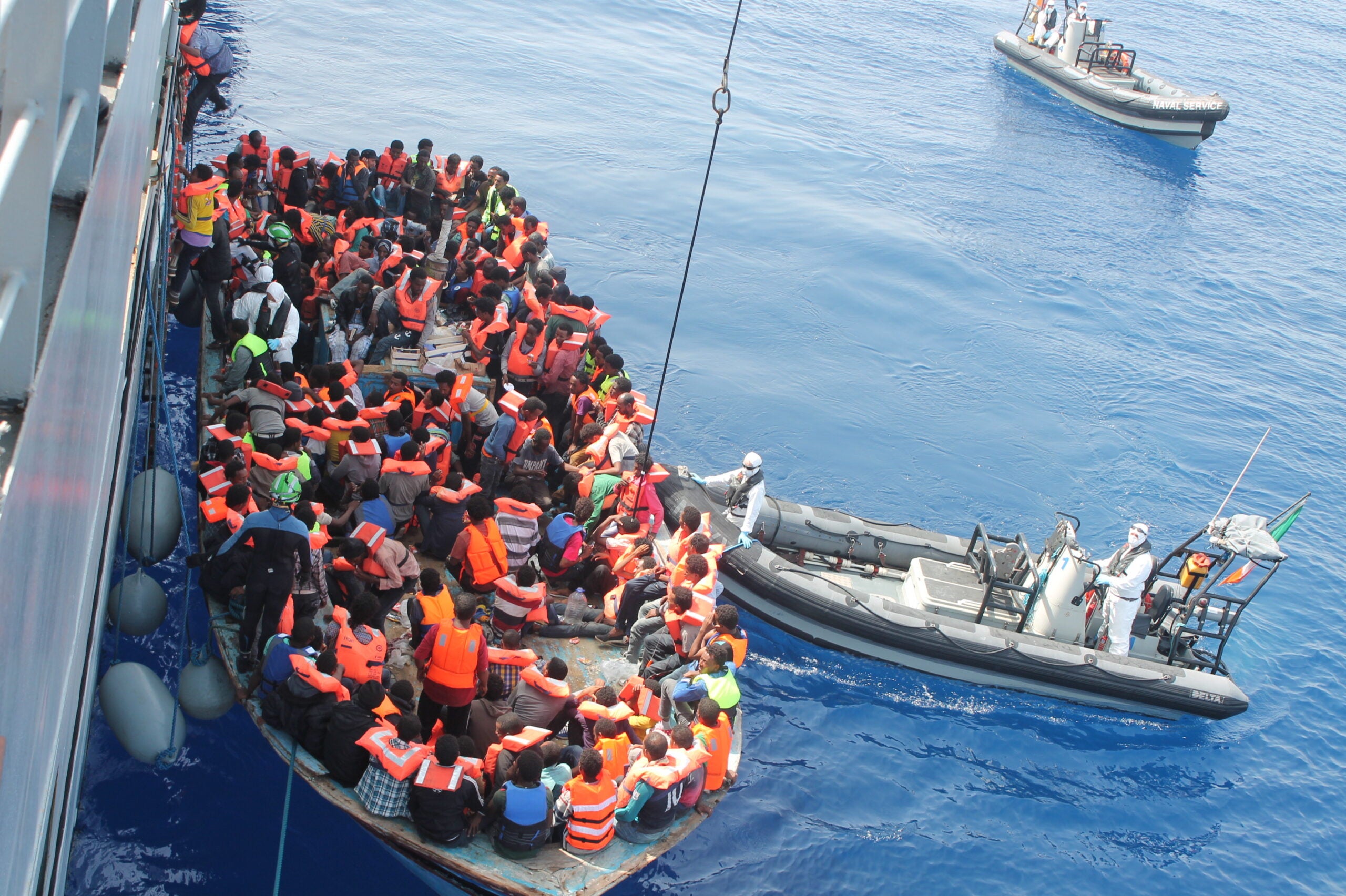
Image Credit: LE Eithne Operation Triton by Irish Defence Forces, CC BY 2.0, via Wikimedia Commons
