
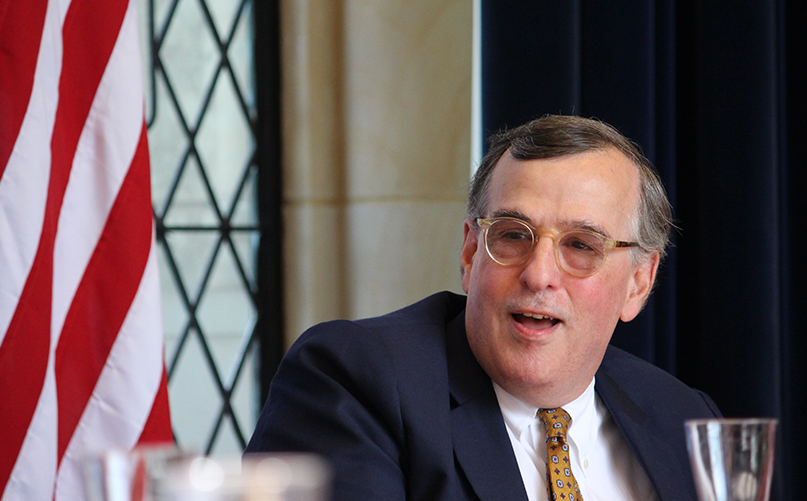
Amb. Frank Lavin on Trade with China Under the Biden Administration
On November 23, 2020, Ambassador Frank Lavin sat down with GJIA to discuss prospects under a new presidency for ending the three-year old trade war. The conversation lays out obstacles to a “reset” faced by a president with clearer pro-trade leanings, including Beijing’s entrenched belief in the inevitability of its superior long-term economic trajectory and dismissal of American objections as rooted in spite.
GJIA: You have recently referred to the US president-elect Joe Biden as generally pro-trade from a left-of-center perspective. Yet, trade–specifically undoing the current trade war with China—does not enjoy bipartisan support. A “return to normalcy” could be interpreted as sacrificing the last administration’s stated goals for a more equitable relationship. After a campaign essentially devoid of foreign policy, and given the left’s issues with initiatives like the Trans-Pacific Partnership (TPP), are there any indications that trade will gain any near-term priority?
FL: In terms of tone and process, there will be a reset because Joe Biden is a different type of person and president. Trump used friction as a management tool. Biden does not have that view of foreign policy. The core geostrategic issues will remain the same: Taiwan is still Taiwan and the South China Sea is still the South China Sea. Concern about China’s role in the region has not gone anywhere. A moderate tone from the White House could ease diplomacy, but it does not alter the fundamental diplomatic challenges in the relationship.
At least on a relative basis, Biden has free-trade credentials. He was supportive of the North American Free Trade Agreement (NAFTA), which was a controversial vote, and his constituencies were against it. In his essay earlier this year in Foreign Affairs, he unambiguously laid out that protectionism is not the right path for America. You have got to have some appetite for trade. I would not describe Biden as a fervent free-trader. But I would say he is committed to the interlinked ideas that America must play a role in international leadership and that the economic benefits of trade exceed the costs. How his position manifests itself in policy and initiatives is a question because we did not get a lot of insight from the presidential campaign. He was running against pronounced trade hawks so he did not want to give the enemy any ammunition. Candidate Biden kept quiet on this set of issues. As president, he will face a fresh batch of trade proposals–like a US-EU trade initiative and the TPP which got going under the Obama administration, but Trump rejected. In fairness to Trump on the TPP, Hillary Clinton and Bernie Sanders were openly opposed. It was not like Trump was turning the light switch from on to off. There are other initiatives out there, like a possible US-UK trade agreement and digital/sectoral initiatives. Biden can take this path in any direction he chooses. But, with campaigning finished, he has to articulate and sell a trade agenda to a domestic audience which is currently conflicted on the idea.
I suspect the main consideration is not going to be, “Are you for or against trade?” Rather, it will simply be about opportunity costs and management bandwidth. There are only a handful of undertakings the president can pursue at one time. He will have to be efficient about his priorities. In his campaign, he indicated his preferences on a range of issues, which were almost entirely domestic. He will have to focus on them in his first year. The curveball to this whole discussion on what might elevate trade on the agenda is when trade becomes geopolitical. The rise of China, and its centrality to the regional economy, can make the trade issue suddenly urgent. It places greater importance on prospective trade initiatives because most, if not all, of the United States’ allies in Asia are in this paradox in which China is their leading trading partner, but their trade preference is for the United States because it is rules-based and lacks territorial ambitions in the region. This makes Washington the best partner to dance with. In this way, it is conceivable that the ongoing rise of China might well produce circumstances which encourage the United States to rejoin the TPP.
Former Treasury Secretary Paulson has said the United States should consider removing tariffs on Chinese goods once it has extracted a “reciprocal and tangible benefit” from China as defined by benchmarks in a phased bilateral trade agreement. What do you see as possible first steps toward status quo ante And, looking back, did this episode have any beneficial impact in the diplomatic messaging to a Chinese government that is increasingly assertive regionally?
I am not sure the United States wants to go back to the status quo ante. I think Biden does not want daily friction because that is not a constructive approach. Using tariffs to direct your trade policy is like using your car horn to steer your car.
The loud signaling achieved by tariffs possibly offers some mild advantages. But we have seen that, chronically, there is a huge cost. The tariff war has already cost American jobs and led to a deterioration in the trade deficit–quite contrary to the advertisement for “America First.” It was a lose-lose policy for both sides. While Biden does not have an appetite for expanding the rates or coverage of tariffs, he probably has some appetite for removing trade barriers. I have recommended to the Biden administration that they proceed to remove all the tariffs imposed by Trump since January 2018 and that, at least in trade terms, he returns to status quo ante. But I do not think the president-elect has the appetite for full-scale repudiation because it would invite a lot of political criticism. There might be some ways to reduce tariffs without repealing all of them, like setting up a blue-ribbon commission to look at it. There are part-way steps he could take. But he has not signaled what he is going to do. Typically, with the US president, there is almost no such thing as a stand-alone trade policy. Trade is a component of foreign policy. What we really need to sort through is determining the United States’ approach to China under Biden and how trade fits into that broader picture.
It is hard to point to any good news out of the trade war effort. You might be able to make the case that there has been some benefit in shock value. To me, though, shock value was never connected to a broader strategy. Any value from being the first president to take things so far dissipates quickly. It can be useful to put an elbow on someone. What was the ultimate goal here? If instead of raising tariffs against China, we lowered tariffs with other trading partners, we would have had the same signal effect on Beijing by saying every Chinese good is now less competitive in the US market. We could have sent that message without anybody at home getting hurt. We would have stigmatized China for its economic inefficiencies while protecting ourselves from collateral damage. This would have been a more sustainable policy. But it would have required a sentiment from the White House that was not there over the last four years in that trade is fundamentally a good idea and we want to seek opportunity for trade on an equitable basis. This simply was not Trump’s way of doing things. He was very skeptical of trade.
There is a theory that China’s leadership is convinced of a long-term US decline or at least stagnation, and that Beijing automatically views any push-back from US foreign economic policy as an effort to blunt China’s inexorable rise. You have written that “China has a somewhat similar challenge: not to view relations with the United States through a lens of historical determinism.” Is this possible under President Xi, and how would China interpret a unilateral reset?
This is a view that you will definitely hear in China. I cannot tell you how prevalent it is, whether it is a rhetorical point or a majority view. But it inevitably circulates in China. I had an interesting conversation with a Chinese scholar at a government-directed think tank. He offered an analogy in which Americans are like the ice skater Tonya Harding. They are ready to whack China on the knee because China is surging toward gold. He was saying that none of the criticisms of China is legitimate, that U.S. complaints are 100 percent based on spite, jealousy, and ill-mannered grumblings. On the other side of the coin, I do not think there has been an authoritarian system that has successfully cracked the code; Beijing understands market-based economics and is getting better results than in the past. Almost by definition, every other system is worse off. If China is the best, everyone else is inferior. That is a widely held view, almost an article of faith. You cannot be the leader of an authoritarian system and say “we might have it right, we might have it wrong,” like what happens in any Western system. China firmly believes they have the superior political or economic model, which gives them superior results. This does not exactly mean Beijing is convinced the United States is destined to decline. But it is convinced China is going to outperform the United States from here. Another point to this dominant narrative in China is that they really have not had any economic contraction in thirty to forty years. Anyone who has lived in a Western economy has experienced a sharp recession at least once a decade. If that is not in your memory, you are much more inclined to subscribe to Chinese economic determinism.
China is not just one participant in the international system. It is now big enough to become a steward of the global order. It has reached a stage of development where it has more to gain from stabilizing than challenging that order.
– Ambassador Frank Lavin
Is it a misinterpretation of China’s objectives to assume that resolving the trade conflict could play a role in softening its regional aspirations, including its stance toward Hong Kong and Taiwan? In other words, is there any obvious path in which a dovish turn in Washington towards the trade relationship can ease tensions in regional security?
I think those two subjects are largely disconnected. China has a mercantilist trade policy that they have adopted for a set of reasons unrelated to their view toward Hong Kong, Taiwan, and the South China Sea. There are also people in the United States who understand China’s trade relations and regional political policy to be separate. But if you are more of a China hawk, you could say an assertive stance within Asia stems from the same stew. Analysts, though, can see that Beijing’s mercantilist trade policy has been a long-held strategy, while its more hardline direction in Hong Kong and the South China Sea is of a later vintage. Recent political developments probably have more to do with their growing economic reach in the South China Sea and increased turmoil in Hong Kong. They were spurred by a separate set of policy drivers.
To my mind, this is an example of the need to return to statecraft, meaning apply the tools you have against a specific task. Avoid dogmatism and stigmatizing the Chinese as an adversary or as evil. There are certain things they are doing in which there is a strong basis for mutual collaboration, like trade or educational exchanges. There are other areas in which US interests are at odds with China, including the status quo in Taiwan and freedom of navigation in the South China Sea. Anytime a country unilaterally tries to change its borders is not helpful for regional stability. But I think we have to make sure we are messaging to Beijing that we have to protect our core interests and we are prepared to pay a price to do so. This is where Trump really fell short. China benefits from the current global trading and political system. The long-term goals of international peace and prosperity that we all share have been enormously beneficial to China. It had a good thirty to forty year run thanks to the World Trade Organization (WTO) process and rules. It is not healthy for China to begin the conversation by claiming the system is intrinsically unfair or China is being treated poorly by the world community. Including that positive narrative is essential to US statecraft. China is not just one participant in the international system. It is now big enough to become a steward of the global order. It has reached a stage of development where it has more to gain from stabilizing than challenging that order. This is not how most Chinese see it. They perceive unfairness toward the country and continue to emphasize the historical inability of a weak China to assert itself. All we are doing, they say, is raising issues everyone else has raised, and yet the world objects to the fact that we can finally stand up for ourselves. They express the narrative of victimhood, that China means no harm and is simply seeking its rightful place in the sun.
What is interesting to me is that all the major powers account for eighty to ninety percent of global GDP and global military size, and yet China is alone in still in the process of defining its international role. China has historically not been part of the European-led international system. They have had so much internal turmoil, destruction, and revolution that it is only in the last few decades that they have become consequential on the global stage. The spotlight is new, both for them and the rest of the world. But everything else we do in diplomacy, almost without exception, is working through normal channels. The only major relation that is still in the process of being defined is China. If I had to leave one insight with the Biden administration, it would be that. Our relations with Europe and our other treaty allies should be quite positive under Biden. As for the more opportunistic powers like Iran and Cuba, there could be trouble. But none of them have the economic heft to change facts on the ground. Only China has the capability to reshape Asia as it sees fit. It bears our attention.
. . .
Ambassador Frank Lavin has held positions in several US administrations, including as US Ambassador to Singapore and Under Secretary for international trade at the US Commerce Department. He is currently a trustee of the Asia Foundation and CEO of Export Now, the largest offshore operator of China e-commerce stores.