
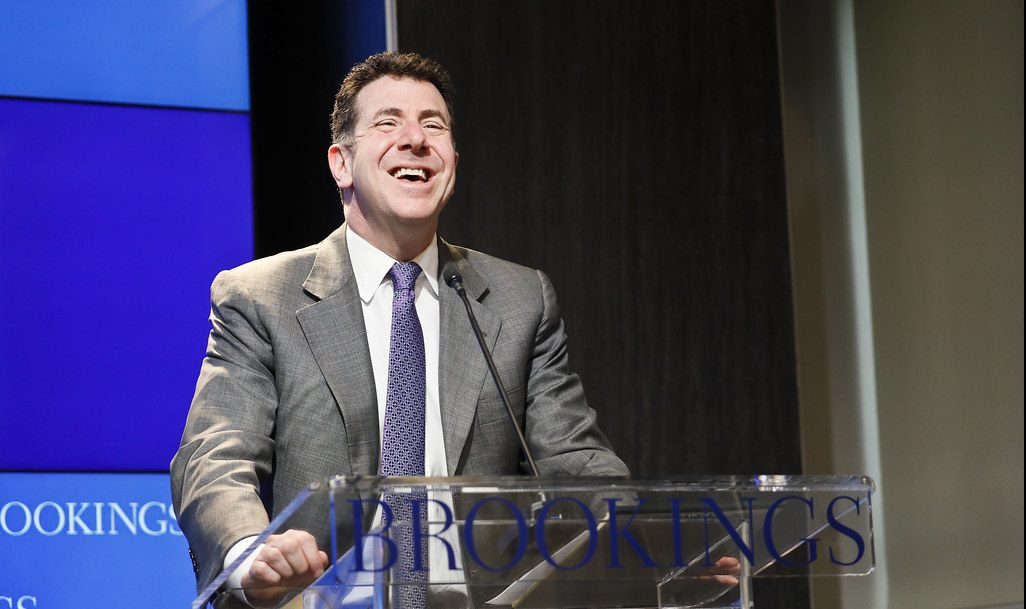
Daniel Byman on Addressing White Supremacy
As the United States grapples with the aftermath of the Capitol riots, Dr. Daniel Byman, Professor at the Georgetown University School of Foreign Service, joined GJIA on February 22nd, 2021 to break down the drivers of the growing white supremacy movement, its increasingly globalized nature, and how the United States and its allies should respond.
GJIA: We have seen white supremacist threats in the past, but in light of the Capitol riots, extremism seems to have garnered much greater concern in the United States and abroad. What factors do you think are causing this movement to become so much more dangerous?
DB: The movement has cycled from being dangerous, to less dangerous, and then dangerous again; there have been ups and downs in recent decades. I would say that there are a couple things that have led to it be of concern in the past few years. One thing is that in the last five years, we have seen it become more lethal than several other sources of terrorism. In terms of focus, our efforts to address issues we cared about fifteen years ago, like various jihadist movements, have become more successful (at least with regard to attacks on the United States). By comparison, some of the white supremacist, anti-government extremists have risen. Part of it is just a relative comparison.
Of course, we have seen these groups incite bloody attacks. We saw this with the Tree of Life attack, as well as with the Walmart attack, so there have been a couple of attacks that were very prominent. But a big thing as well is that these movements are more interwoven with US domestic politics. We saw this on January 6 with the storming of the Capitol. It is not as if the people storming the Capitol were part of mainstream politics, but they were encouraged by the [former] president of the United States; there were several elected officials who have been supportive of them. We have seen rhetoric afterward from various state legislators who have been supportive. I would say a big difference is that some of the groups have ties, or at least echoes, in mainstream political debates. That changes how we think of them, and it makes them a concern beyond the lives lost—it makes them a political concern.
Touching on these political concerns, with President Trump out of office, do you believe that white extremism might erode? What is the future of white supremacy?
We do not know. With Trump out of office, there will be a major player who will not be encouraging extreme anti-government groups. But at the same time, large numbers of Americans, not just extremists, believe that the election of Joe Biden was illegitimate. That is a very powerful motivating force either for doing violence or at least for tolerating it, so there are many who are very skeptical and aggrieved at the current government. Making it all a bit more complex is that the federal government is already more aggressive against these groups than it was several years ago. So there is a question of the threat, but there is also a question of the response to the threat. Some of these groups have been given a free ride, and I think that is much less likely to occur now.
Given the partisanship on white supremacy, do you believe that the Biden administration will still be able to effectively respond to this threat?
I think the Biden administration will still be able to effectively respond, and I believe that they will have the support of the vast majority of Republicans. I am very hopeful about this. That said, there is an overlap: where white supremacy begins and where anti-government groups start is an open question. There is a lot of overlap in these communities, and much of their agenda is linked to things like ‘Stop the Steal’ (protesting results of the election), which are shared well outside extremist circles.
I think there will be support for going after the most extreme versions and the most racist types. That said, a lot of the groups are just networks of individuals, so it will be hard to go after them without touching on some of the more mainstream issues that these networks champion.
That said, there is an overlap: where white supremacy begins and where anti-government groups start is an open question. There is a lot of overlap in these communities, and much of their agenda is linked to things like ‘Stop the Steal’ (protesting results of the election), which are shared well outside extremist circles.
– Professor Daniel Byman
Following the Capitol riots, authorities in Germany tightened security around their parliament in case German far-right groups became inspired. An analysis by the New York Times also illustrates that one-third of white extremist attacks across the globe were inspired by similar attacks. Given that the spread of white supremacy is increasing through the internet, how do you think the government or social media companies should respond?
The good news is that social media companies have been much more aggressive in recent years. The deplatforming of President Trump is one very notable example. In terms of the most extreme groups, we have seen a lot of them kicked off Twitter, Facebook, YouTube, and so on. There has been real progress in how these companies treat these groups compared to four or five years ago.
That said, it is extremely hard. If you look at, for example, the Christchurch attack, where fifty-one people were killed when extremists attacked two mosques, Facebook was really aggressive and trying to take content down—it really responded quickly. But the internet is the internet; the manifesto, the video, and the attack were widely viewed, and it was very hard to stop. I think that [stopping the spread of extremist content] is going to be a constant struggle. But the good news is that technology companies are much more willing to engage in this than they were three or four years ago.
There have also been reports of Americans traveling to far-right camps in Ukraine, German neo-nazis traveling to the United States, and so forth. How dangerous do you think these cross-national ties are, and how should the United States and its allies respond?
The cross-national ties are pretty dangerous; when someone goes to a warzone, like Ukraine, to train, they can become more lethal and become connected to a lot of other individuals they might not otherwise know. They can become more diehard in their beliefs, so there are a lot of concerns.
However, if you are watching for this, there are a lot of ways you can stop it. Global intelligence and law enforcement cooperation are very important. Sometimes these people commit crimes when they are [traveling], so there are a lot of opportunities to disrupt this activity. If you look at the jihadist side of this twenty-five years ago, people traveling abroad to fight was a huge problem and a huge source of terrorism. It still is a concern, but counterterrorism has become so much better that when people go abroad to fight, they are much more likely to be caught. In fact, when they travel abroad, they are much more likely to reveal the existence of many other people that the government does not know about. So it is a potential danger, but it is also a potential vulnerability for the group if the government is aggressive.
Do you believe the Biden administration and its allies are switching gears and taking some of these approaches? Are they taking the right steps so far?
It has not really begun. For example, Merrick Garland is going through confirmation hearings for attorney general, and that will be one of the most important positions for this. He has said, “One of my priorities is going to be domestic terrorism,” so that is encouraging. It is relatively early in the administration, so I think it is too early to tell. But I would say that the rhetoric is very encouraging. If you look at what they are saying, that is promising, but they have to follow that up.
If you were to nail down a couple of policy recommendations for the administration to combat domestic terrorism, what would you recommend that past governments have not done before?
Resourcing: several of these groups are very vulnerable, but you need Federal Bureau of Investigation (FBI) agents, law enforcement, and a whole host of people willing to go after [these groups]. Part of it is resourcing, but part of it is also treating it very seriously. Right now, a lot of these groups commit low-level crimes. They are kind of ignored, because [law enforcement] is so focused on high-level violence. But if you are trying to go after a network, you can go after the low-level crimes and start to put pressure on the movement as a whole. There is a lot that you can do if you treat them more aggressively.
What is the composition of white supremacists? It seems that there are some loners, and then there are some more organized units. How should we think of this?
There certainly are a few more organized groups, but most of the organized, violent groups have been shut down or are relatively small. It tends to be lots of individuals operating as networks, often via social media. [They] encouraged other people, and some of those people turned violent. If you look at the people who [were involved in] the Walmart shooting, the Tree of Life shooting, and the black church in Charleston [shooting], those were all inspired individuals, not people who were a part of groups. I think that is where the real danger is, and in some ways, it is a harder challenge. Groups can achieve a lot more; they tend to be more capable and more dangerous. But, they are also easier to detect. The individuals are really hard to find, and as a result, hard to stop.
. . .
This transcript has been lightly edited for clarity and length.
Dr. Daniel Byman is a professor at the Georgetown University Walsh School of Foreign Service, a senior fellow in the Center for Middle East Policy at Brookings, and a foreign policy editor at Lawfare. Byman previously served as a staff member with the National Commission on Terrorist Attacks on the United States (“The 9/11 Commission”) and the Joint 9/11 Inquiry Staff of the House and Senate Intelligence Committees. He is the author of numerous books on counterterrorism, and his latest is “Road Warriors: Foreign Fighters in the Armies of Jihad”(Oxford University Press, 2019). Follow him on Twitter @dbyman.
Image Credit: Paul Morigi (Creative Commons)