
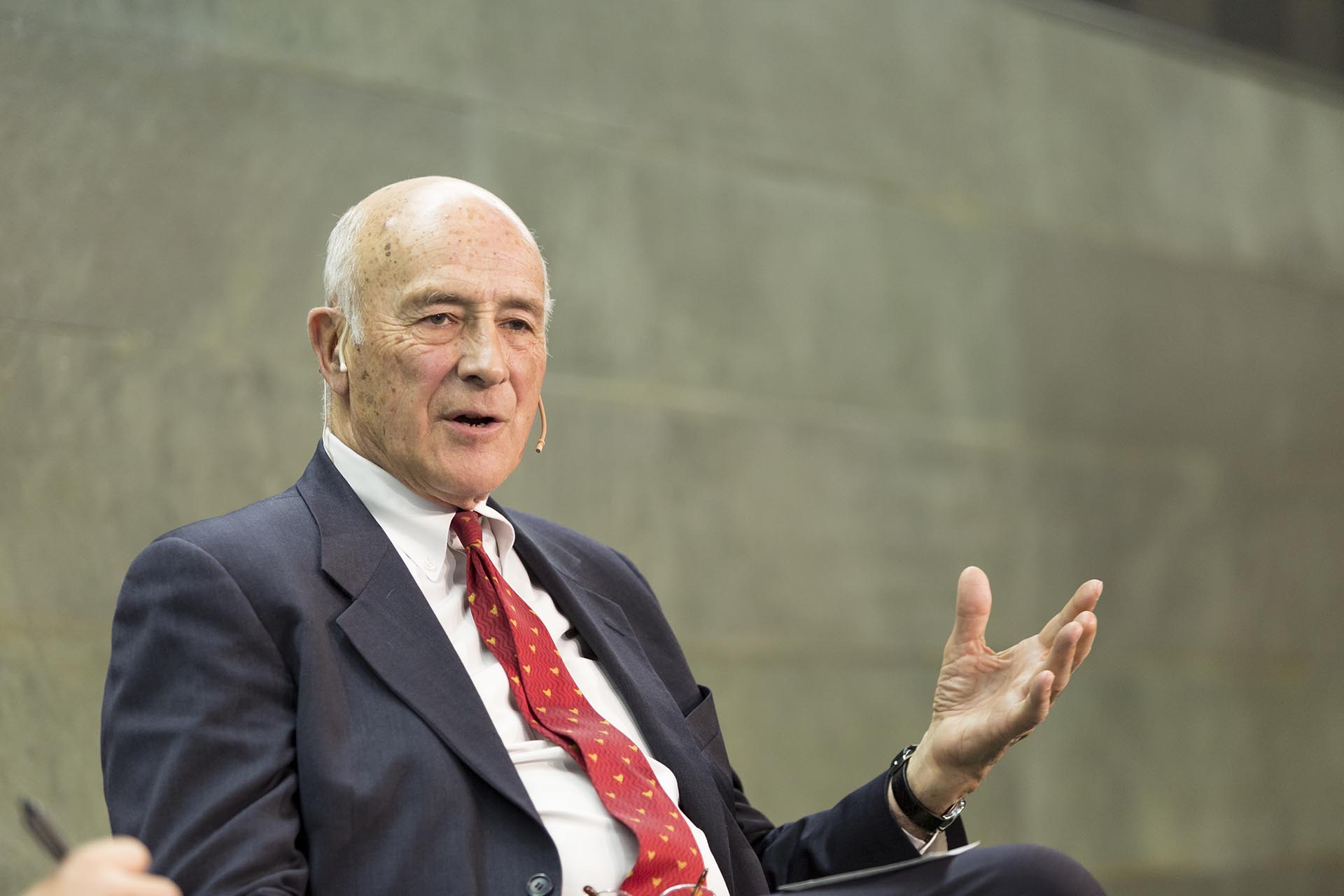
Dr. Joseph Nye on “Do Morals Matter? Presidents and Foreign Policy from FDR to Trump”
At its headquarters, the Center for Strategic and International Studies (CSIS) welcomed Dr. Joseph Nye, the founder of neoliberalism and former Dean of Harvard Kennedy School, for a conversation on his most recent book “Do Morals Matter? Presidents and Foreign Policy from FDR to Trump.” Following the event, GJIA sat down with Dr. Nye to discuss the ethics of U.S. foreign policy since 1945, U.S.-China relations, and the contest for soft power.
GJIA: In your new work “Do Morals Matter,” you ask a seemingly simple but ambitious question: “Do morals matter in American foreign policy, or is American moralism just hypocrisy as realists teach us?” Having now finished the work, what is your concise answer to this?
JN: I think morals do matter, and what I try to do in the book is to argue that if you took the view that morals do not matter, you will not be able to understand the history of the last seventy years. I look at the fourteen U.S. Presidents since 1945 and show how many decisions were affected by their moral views—not what you would predict from just a realist analysis of national interest.
Your book also offers a three-dimensional scorecard of intentions, means, and consequences that one can use to assess the morality of foreign policy decisions. How does this framework enable scholars to better evaluate the extent to which ethical considerations have impacted foreign policy?
I think that there is a great tendency for Americans to mistake morals with morality. Morals do not mean speaking fancy words about morality. Morality means combining the intentions or motives, the means that you choose, and the consequences that you have into one single package. That package has to be assessed as a whole, not only taking into account the intentions or, alternatively, just the consequences. Sometimes people think that if a policy turns out well for our interests, that makes it good. To which, my answer is no. If you ask what is a good foreign policy, it has to include not only motives but also the means and consequences attached.
As you note in the book’s introduction, Henry Kissinger observes that tough decisions are 51-49. In “World Order,” he argues that “to strike a balance between the two aspects of world order—power and legitimacy—is the essence of statesmanship. Calculations of power without a moral dimension will turn every disagreement into a test of strength.” What do you make of this statement?
I agree with Henry on that. He was one of my professors when I was a graduate student. I think that he is often judged as a complete realist with no sense of the importance of values, and that is not right. As that quote illustrates, he understands that values can produce soft power and that the foreign policy of successful countries has to be able to combine both “hard” and “soft” power in order to produce a legitimate policy.
In a recent article on Project Syndicate, you emphasize that “oil, arms sales, and regional stability are national interests, but so are values and principles that are attractive to others.” How well, if at all, have American presidencies since 1945 balanced these two priorities?
Some presidents have been much more effective in terms of soft power, and some less so. I think you can argue that President John F. Kennedy, with his rhetoric, generated a good deal of soft power in the sense of attraction towards America. I think you can argue that Richard Nixon, with his policies in Vietnam, undercut a good deal of American soft power. Jimmy Carter, with his human rights policies, restored and developed a good deal of American soft power. I think you can also argue that George W. Bush, with his invasion of Iraq, undercut American soft power. What I also think is interesting is that when Barack Obama was elected, as judged by public opinion polls, there was a great revival of American soft power and that under Donald Trump, the polls show that American soft power is at an all-time low.
I think what all of this suggests is that the ability of Americans to attract others varies with government policies. Different presidents have had different effects. I also think that a great deal of American soft power is generated by civil society, and that tends to be more permanent. I suspect that even after the Trump administration, whenever that ends, there will be a recovery of American soft power.
I [also] think that a great deal of American soft power is generated by civil society, and that tends to be more permanent. I suspect that even after the Trump administration, whenever that ends, there will be a recovery of American soft power.
– Dr. Joseph Nye
If it is true that American soft power has declined under the current administration given its lack of attention to public diplomacy, what impact does this have, if any, to the U.S.–China contest for exerting soft power abroad?
Well, fortunately, the United States is still more attractive than China in soft power, measured by public opinion polls or rankings done by the Soft Power 30 Report, a British Index. This really has a lot to do with the nature of American society and Chinese civil society. China is spending a great deal of money to increase its soft power, but they are not willing to unleash their civil society. Through its policies, the Chinese government sometimes interferes with the ability of Chinese civil society to produce soft power. This occurs when people like Liu Xiaobo and Ai Weiwei, who might be seen as admirable and might attract others, are essentially undercut by the government’s policies. The United States government has also implemented ignorant policies, which leads people to lose attraction towards the United States. Fortunately, American civil society does not obey the government. For example, the Vietnam War was a government policy that had people marching in the streets throughout the world in opposition, but the protesters did not sing “L’Internationale.” They sang Martin Luther King’s “We Shall Overcome.” I think that this shows precisely the strength of American soft power when compared to Chinese soft power.
Citing President Truman’s commitment to accept stalemate during the Korean War rather than following Douglas MacArthur’s advice of using nuclear weapons, you have stressed the need to consider the “ethical consequences of nonactions.” How should historians judge the morality not of actions, but rather of inaction?
I think as Sherlock Holmes has alleged to have said: “The dogs that do not bark can tell us a lot.” Historians who are really thinking carefully about history have to ask not just what explosions have occurred but what explosions did not occur and what decisions prevented these explosions from occurring.
An endless debate among scholars of international relations has been whether the world will look unipolar, bipolar, or multipolar. Why has this debate of polarity remained so controversial, and what is your verdict on this?
One of the problems is that of terminology. When you ask in military power, how does the world look, it still is unipolar. No other country has the capacity to project military power on a global scale other than the United States. However, at the economic level, the world is multipolar. You have the United States as the largest economy, China as the second-largest, the European Union as the third, and Japan as the fourth. That is a multipolar world. When you look at the level of transnational relations—things that cross borders and are outside the control of governments—the world is not “polar” in that sense at all. It is chaotically organized. In that sense, the whole terminology of “polarities” can confuse us. We have to think more subtly about the different ways in which power is distributed, which really relates to different types of issues, rather than assuming that there is a single unipolarity or multipolarity of power that dominates the whole world.
Technological advances enable states to inflict pain upon other states without having to engage in armed conflict. As the conflict between the United States and Iran (as well as China) intensifies, policymakers and scholars question how and where a war may occur next. Would it be in the cyber domain as some scholars predict?
Well, I hope that there will not be another war, but I think that some of the descriptions of cyber warfare are somewhat exaggerated. We have some scholars maintaining that we are already involved in a cyberwar because there have been so many cyber attacks. However, as of yet, no human beings have been directly killed in a cyberattack, so I think we may be mistaken if we try to amalgamate everything under the rubric of war. We must remember that we have had the War on Poverty, the War of the Sexes, and so forth. Maybe we should reserve war for what it was originally used for and talk about the different types of conflicts rather than trying to fit them all under this rubric of war.
You recently highlighted how some of President Trump’s foreign policy decisions are not unprecedented for U.S. Presidents since World War II, reiterating that Trump is not unique but only extreme. Can you elaborate on this observation?
In the book, Do Morals Matter, I try to look back and ask the question: can you see behavior by other presidents that are similar to that of President Trump? The answer is yes. In that sense, Trump is not unique. On the other hand, some of the behaviors such as telling lies—which President Roosevelt did and President Nixon did—is not unique; they told them too, but not to the extent that President Trump has. If the Washington Post is correct that President Trump has made 15,000 lies within his first 1000 days in office, that was never true of President Roosevelt or President Nixon.
The notion of “soft power” you formulated two decades ago remains vigorously discussed, debated, and reexamined, gaining renewed attention. Has the meaning evolved over time, especially in light of the rise of social media?
Many people have treated soft power in different ways. One of the problems of being a father of a concept is that you cannot control your child ever more than a father can control an adolescent teenager. People will sometimes say that soft power is anything that is not military power. That is not how I conceived or defined it. Soft power is particularly the ability to affect others without the use of coercion or payment, by means of attraction. In that sense, the basic meaning of soft power has not changed. On the other hand, the various resources which can produce attraction have changed, and the rise of social media has certainly added a great deal in terms of the means by which people can produce attraction or repulsion.
This transcript has been lightly edited for clarity and length.
Joseph S. Nye Jr. is the University Distinguished Service Professor and former Dean of the Harvard Kennedy School. He previously served as Chair of the U.S. National Intelligence Council, Assistant Secretary of Defense for International Security Affairs, and Deputy Under Secretary of State for Security Assistance, Science and Technology. Dr. Nye is considered a founder of soft power and the international relations theory of neoliberalism. In a recent survey of international relations scholars, he was rated the fifth most influential over the past 20 years and ranked as the most influential scholar on American foreign policy. In 2011, Foreign Policy named him one of the top 100 Global Thinkers. He received his bachelor’s degree from Princeton University, won a Rhodes Scholarship to Oxford, and earned a Ph.D. in political science from Harvard.