
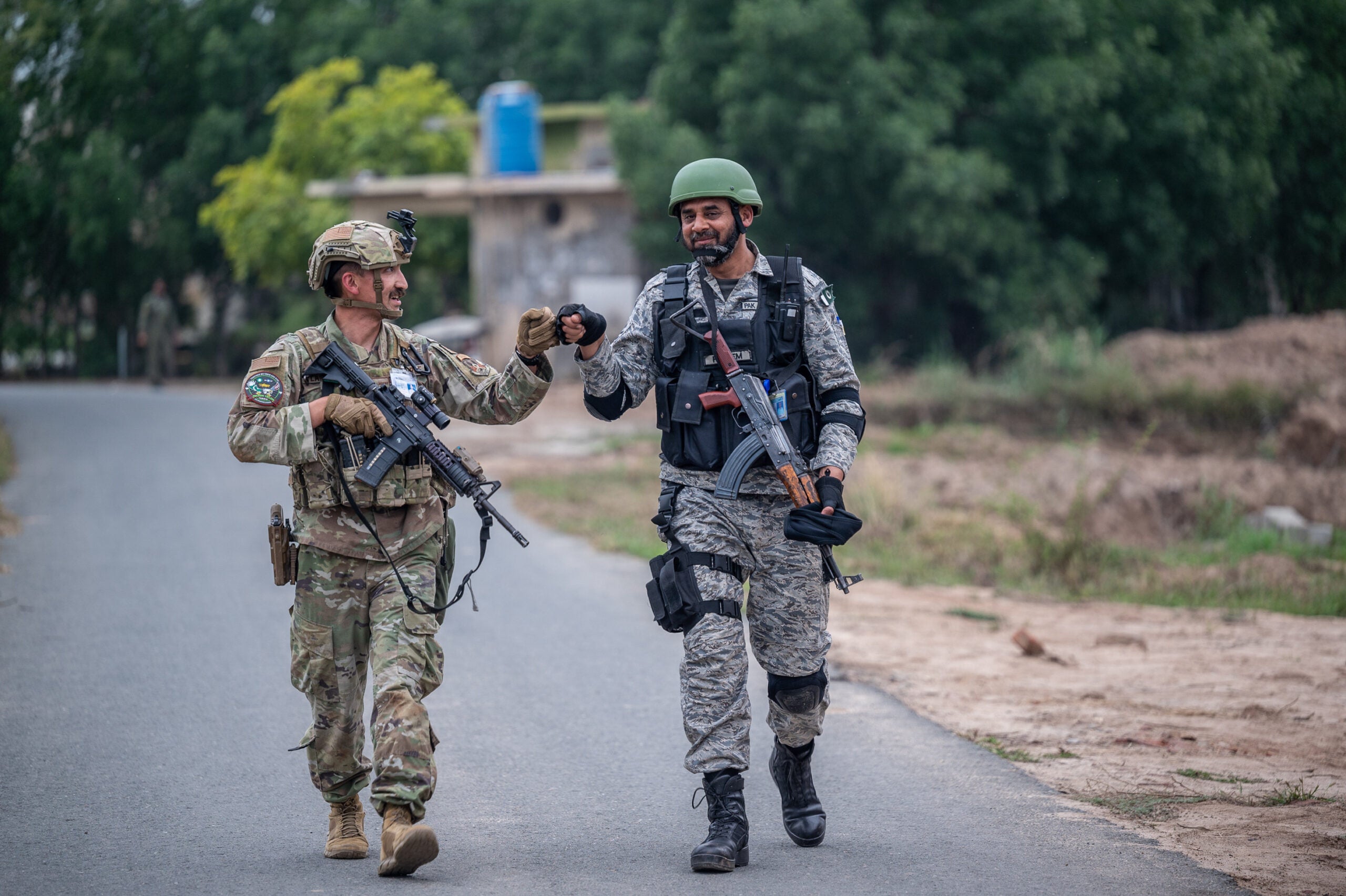
The Saudi-Pakistani Defense Pact and U.S. Force Posture in the Gulf
On September 17, 2025, Saudi Arabia and Pakistan signed the Strategic Mutual Defense Agreement (SMDA), a mutual defense pact that formalized the countries’ security partnership. In this interview, Dr. F. Gregory Gause analyzes the SMDA and its impact on U.S. interests in the Persian Gulf. Dr. Gause argues that the pact served as a diplomatic signal from Saudi Arabia to the United States, through which Saudi Arabia sought to extract greater security commitments from President Trump. While the pact is unlikely to dramatically impact U.S. relations with its Gulf partners, it may reinvigorate efforts to enhance military interoperability and security cooperation.
Georgetown Journal of International Affairs: Before discussing the Saudi-Pakistani defense pact itself, could you please provide a brief overview of the historical nature of defense relations between Saudi Arabia and Pakistan?
F. Gregory Gause: Saudi Arabia and Pakistan have maintained a long-standing defense relationship. Beginning in the 1970s, Pakistan periodically stationed troops in Saudi Arabia for training purposes, border protection, and other military exercises. Reports indicate that Saudi Arabia may have helped finance the Pakistani nuclear program, leading to speculation that Saudi Arabia conditioned its support on an informal Pakistani pledge to extend its nuclear deterrence and defense support.
GJIA: What motivated the Saudis to formalize their military relationship with Pakistan after years of informal collaboration between the two countries?
FGG: Officially, Pakistan and Saudi Arabia have been engaged in discussions about a renewed security cooperation agreement for months. I would argue that the two countries’ decision to publicize the pact stems predominantly from the Israeli attack in Doha, Qatar. Qatar served as a mediator between Israel and Hamas during the recent war in Gaza, and in September 2025, Israel targeted a Hamas delegation in Doha. The attack startled and frightened Gulf states, whose leaders believed that their close partnerships with the United States would deter Israel from conducting counterterrorism operations on their soil. Within this context, the announcement of a Saudi-Pakistani security agreement likely served as a message from Riyadh to Washington. The SMDA implicitly conveys that, if the United States cannot prevent Israel from striking its other Middle Eastern allies, the Saudis would turn to other security providers. This is partially a bluff because Pakistani support cannot substitute for U.S. weaponry, security cooperation, or regional force posture. As such, the pact primarily functions as a diplomatic signal to the United States, calling on the Trump Administration to augment its support for Gulf states’ security.
GJIA: To what extent do you think that the Iranian nuclear program influenced Saudi decision-making?
FGG: Saudi opposition to the Iranian nuclear program is not a recent phenomenon, so I do not see the SMDA as directly tied to Iran-related threats. The Iranian program faced a major setback in the Twelve-Day War between Israel and Iran in June 2025, during which the United States joined Israel in bombing Iranian nuclear facilities. While the Saudis have expressed concern about the Iranian nuclear program since its inception, the program did not pose an imminent threat when the pact was announced. Although concerns about Iran may have motivated the Saudis to develop a new security arrangement with Pakistan, they do not appear to be the driving force behind the renewed military cooperation.
GJIA: What do you view as the SMDA’s key components? What do we know about the pact, seeing as the precise text has not yet been released?
FGG: There is significant ambiguity surrounding the extent to which Pakistan will extend nuclear support to Saudi Arabia. If Saudi Arabia were attacked, could a Pakistani response entail the use of nuclear weapons? Although the Pakistani Minister of Defense implied that the pact entailed a nuclear commitment to Saudi Arabia, he quickly reneged, denying that the agreement required Pakistan to use nuclear weapons in the defense of Saudi Arabia. I find it highly unlikely that Pakistan would use nuclear weapons to repel attacks on Saudi Arabia. The Pakistani nuclear capability exists to deter its chief adversary, India. If Pakistan reduced its own nuclear capabilities to protect Saudi Arabia, Pakistan would leave itself more vulnerable to attacks from India. [Note: This interview was conducted before the U.S.-Israeli war on Iran began in late February 2026. More than two weeks into the war, with Iran retaliating against Saudi Arabia and other Gulf states, Pakistan has taken no public steps to support the Saudis or attack Iran in response.]
GJIA: How do you think that this pact impacts great power competition in the region, with Pakistan being both a major non-NATO ally and a significant recipient of Chinese arms?
FGG: In my opinion, the pact does not significantly affect great power politics in the Persian Gulf. The United States has maintained security relationships with Gulf states for several decades, as demonstrated by its enduring military presence in the region. The Fifth Fleet is homeported in Bahrain. Qatar hosts the largest U.S. air base in the Middle East. Between 5,000 and 10,000 U.S. troops have remained stationed in Kuwait since the Gulf War of 1991, and the United States retains access to military bases in both Oman and the United Arab Emirates. The United States possesses a long-standing security relationship with Saudi Arabia. Given the entrenched and long-standing security ties between the United States and Gulf states, I do not foresee the SMDA significantly altering U.S. involvement in the region.
GJIA: How will the Saudi pact impact ongoing negotiations between Saudi Arabia and the United States regarding a mutual defense treaty?
FGG: In the wake of October 7th and the Israel-Hamas War, I do not foresee the imminent ratification of a U.S.-Saudi defense treaty. When the Biden Administration sought to broker a mutual defense treaty in 2023, it packaged the treaty as part of a Saudi-Israeli normalization agreement. The defense treaty likely included U.S. support for building civil nuclear infrastructure in Saudi Arabia, ostensibly for peaceful purposes. The Biden Administration hypothesized that tying this treaty to normalization would generate the requisite two-thirds majority to ratify it in the Senate. Hamas’s October 7th attack and the subsequent Israel-Hamas War destroyed these aspirations, and the Trump Administration does not appear to have revived treaty negotiations. In any event, I doubt that Senate Democrats would support a treaty negotiated by President Trump. In this polarized political environment, a standalone defense treaty is unlikely to obtain the requisite 67 votes needed for ratification in the Senate.
Rather than a defense treaty, the Trump Administration will probably devise a renewed Saudi security agreement based upon the security guarantees promised to Qatar in September 2025. Such an agreement would codify the U.S. commitment to Saudi Arabia’s defense and willingness to cooperate on developing Saudi Arabia’s indigenous military capabilities. Of course, the United States has engaged in these activities for decades through sales and training. Therefore, I do not foresee a new treaty, but rather a codification of the existing partnership.
GJIA: As you previously noted, the United States has a vast military presence in the Gulf. What do you think the United States should do to improve its relations with Gulf countries and maintain its regional posture?
FGG: The United States maintains a strong presence in the Gulf and does not need to dramatically alter it. The bigger debate in U.S. strategic circles is, “How committed should the United States be militarily in the Persian Gulf region?” Some scholars view U.S. involvement in the Middle East as detracting from the most important strategic challenge, which is posed by China. President Obama, President Trump, and President Biden all campaigned on the idea that the United States was overcommitted in the Middle East and needed to devote greater attention to the rise of China. Ultimately, none of these presidents was able to extract the United States from Middle Eastern politics. They all maintained important military partnerships and conducted military operations in the region. Gulf oil remains a strategic commodity, and much of the international community continues to view Iran as a threat. To truly address the multifaceted threats in the region, a redoubled effort to increase military interoperability and encourage cooperation on missile defense issues is critical. Pushing the Gulf states to build a truly unified defense system would serve as a force multiplier, replacing the currently independent and uncoordinated practice of each Gulf state buying the weapons it wants and acting unilaterally on defense issues.
Furthermore, the United States should reassess its policy toward Iran. I supported the Joint Comprehensive Plan of Action (JCPOA), the nuclear deal with Iran negotiated under the Obama Administration. The current Trump Administration’s unwillingness to engage with Iran represents a lost opportunity to build upon the United States’ successful military strikes in June. Iran is weak, and the United States should take advantage of its current state to resume negotiations aimed at limiting Iran’s ability to redevelop its nuclear program. [Note: This interview was conducted before the U.S.-Israeli war with Iran. The interviewee is not supportive of the war and questions the Trump Administration’s intentions in initiating it.]
This transcript has been lightly edited for clarity and length.
. . .
F. Gregory Gause III is an associate fellow of the Middle East Institute in Washington, D.C. and Professor Emeritus of International Affairs at the Bush School of Government and Public Service, Texas A&M University. He is the author of three books and numerous articles on the international politics of the Middle East, with a focus on the Arabian Peninsula and Persian Gulf, and on American policy in the region.
Image Credit: Master Sgt. Christopher Parr, Public domain, via Wikimedia Commons
