
War, Erasure, and the Politics of Culture in Sudan
This article examines contemporary cultural erasure in Sudan. It highlights resilient Sudanese efforts and international collaboration, positioning cultural heritage as essential infrastructure for truth-telling, reparations, and inclusive post-war nation-building. It advocates for urgent policy integration to counter polarization and historical revisionism for a plural future.
Two millennia of inhabitation by indigenous groups, immigrant and diaspora communities, and many others who made the land their home have shaped Sudan’s cultural legacy along the two Niles. Today, over 120 languages connect Sudan’s territories and diasporas, exemplifying the country’s immense diversity as the result of its complex history. However, contemporary legislation, such as the “Strange Faces Law,” questions who is truly Sudanese, leading to the arrests of people suspected of being from Darfur or Kordofan based on their facial features and skin tone. As such laws polarize the country and the War ravages it, Sudan must act against them to preserve national unity.
In April 2023, the war in Sudan erupted in the capital, Khartoum, between the Rapid Support Forces (RSF), commanded by General Muhammad Hamdan Dagalo Musa (Hemedti), and the Sudan Armed Forces (SAF), led by General Abdel Fattah al-Burhan. Former President Omer Al Bashir integrated the RSF into the SAF in 2018, but the RSF retained operational autonomy, funded by gold mines under its control. The RSF itself evolved from the militia Janjaweed, infamous for atrocities committed in Darfur since the 1990s. The escalation of the rivalry between al-Burhan and Hemedti has led to the current violent conflict. Thus far, combatants have deliberately targeted health and education systems, and essential services have collapsed.
The conflict ranks among this century’s most urgent humanitarian crises, and yet, international intervention remains limited, forcing Sudanese-led initiatives, such as the Emergency Response Rooms and Community Kitchens, to carry the burden of humanitarian response with minimal resources and a heavy reliance on volunteer work and donations from the diaspora. The limited array of international responses focuses on immediate needs such as medical care, shelter, food, water, sanitation, and education. As a result, the significant and often irreversible damage to Sudan’s cultural heritage and artistic community receives less attention and support. This overlooked destruction and subsequent inaction, however, fuel cycles of violence and erode community cohesion, positioning policies that safeguard Sudan’s cultural heritage on a broader scale as a prerequisite for post-conflict recovery.
Mapping the Damage: Tangible and Intangible Losses
Destruction and theft of cultural heritage have a long history as deliberate strategies to exert power in Sudan. Such policies of erasure and marginalization trace back to colonial-era policies where Khartoum, as a central hub of administration, utilized them to oppress and ostracize Darfuri, South Sudanese, and other peripheral histories.
Today, the RSF targets archives, libraries, and museums as tools to control memory and legitimize their dominance, often under the pretense of revenge against the Khartoum elites who have long sidelined the rest of Sudan. UNESCO’s risk and damage assessment and Sudanese-led initiatives confirm that out of 139 at-risk heritage sites—museums, world heritage sites, archeological sites, and important private collections—ten museums and cultural centers have been looted, stolen from, and vandalized in the past 1,000 days. However, due to present-day access constraints, especially in areas where active fighting continues, significant data gaps create an incomplete picture of damage. Satellite imagery, crowdsourced reports, and diaspora efforts are beginning to fill these information gaps, suggesting the true scale of damage far exceeds current estimates.
For example, RSF forces looted the National Museum in Khartoum in June 2023. A video circulating on social media shows fighters entering the bioarcheology lab of the museum, opening storage containers with mummies, and claiming the mummies were victims of the dictatorship of al-Bashir. The director of the National Museum, Dr. Ghalia Jar Al-Nabi, reacted to the viral clip, stating that she is “worried about where else they might have gone in the museum that no one filmed, and what else they are going to do.” Director Ikhlas Abdellatif of the Sudanese National Corporation for Antiquities and Museums (NCAM) accused RSF forces of smuggling artifacts to Chad and South Sudan for sale to art dealers and private collectors. Some artifacts have resurfaced on platforms such as eBay.
Additionally, the destruction of institutions such as the National Recording Office in Khartoum, which held unique documentation dating back to the mid-19th century, has resulted in the loss of vast amounts of data. Erasure of records prevents the uncovering of continuities of violence perpetrated by colonial powers, past abuses of power by Sudanese governments, corruption, or even legal precedents, effectively erasing the historical basis for current legal and social rights.
Sudanese cultural heritage faces threats not only through active displacement and destruction, but also through targeted violence against artists, musicians, poets, archivists, and other cultural workers. The yearly parade in Omdurman on the day of the Prophet’s birthday exemplifies events that have not been celebrated since the outbreak of the war. Smaller religious and linguistic communities in places including the Nuba Mountains and Darfur risk outright extinction amid mass displacement and death, with over 50 Sudanese languages at risk. Unlike traceable artifacts, these losses erode irreplaceable networks, transmission chains, and social spaces. Policy must therefore target both material safeguards and living practices to rebuild and restore cultural infrastructure.
Sudanese-Led Preservation Efforts
Several initiatives demonstrate that targeted local engagement and international collaboration can effectively combat cultural erasure in Sudan. They provide policy models that should be better supported by international donors.
Safeguarding Sudan’s Living Heritage (SSLH) is an initiative funded by the British Council and run by Sudanese archivists and cultural workers who conduct research, create maps, and curate exhibitions. They collaborate with vulnerable communities in Sudan and in exile to document their culture and help build resilience. The SSLH is one of the only groups currently dedicating its efforts to safeguarding intangible heritage on a global scale. Similarly, Blue Shield Sudan, established in December 2024, constitutes the first nationally coordinated cultural protection body founded during the Sudanese conflict. Led by Professor Intisar El-Zein Soghayroun, it connects various initiatives in Sudan that defend cultural identity.
In a more decentralized way, neighborhood committees, women’s groups, and youth groups have recorded stories from community members. Local radio stations, podcasts, and social media channels run by Sudanese creators have served as the vessels of this preservation, broadcasting oral histories and music as acts of resistance. Examples include private initiatives that contribute to the archiving of knowledge and raising of global awareness, such as Omer Al Tijani’s “Sudanese Kitchen” cookbook and Hana Baba’s “Folktales from Sudan” podcast.
Individually, visual artists, filmmakers, photographers, and performers document and preserve wartime life, atrocities, flight routes, and stories, as well as life in exile. Artists have employed street art and graffiti, as well as digital art, to commemorate massacres and disappeared persons in Sudan. These initiatives have revealed the potential and power of Sudanese art to connect the diverse population and overcome the ongoing crisis. They ultimately contribute to fostering community and preserving cohesion in a country increasingly torn apart by war.
These efforts, from nationally coordinated heritage protection such as the SSLH to grassroots storytelling, such as the podcast and book project, illustrate a diverse and community-driven movement resisting Sudan’s cultural destruction. They show how creative resilience and civic solidarity can preserve plural identities during active conflict and with minimal resources. Building on these examples, it becomes clear that integrating cultural preservation efforts into policy frameworks is not only valuable and possible but also necessary.
Importantly, Sudan acceded to the 1954 Hague Convention for the Protection of Cultural Property in the Event of Armed Conflict and has recently joined the 1970 UNESCO Convention on the Second Protocol on the Means of Prohibiting and Preventing the Illicit Import, Export and Transfer of Ownership of Cultural Property. These actions strengthen Sudan’s legal and institutional framework for protecting cultural property and create a base for international collaboration to counter illicit trafficking. As such, they enable a greater cooperative breadth within which cultural preservation initiatives can be coordinated and integrated, and ultimately constitute the legal foundation of any future policy.
Why Prioritize Culture: Rationales for Policy Integration
The widespread destruction and displacement in Sudan have created a critical threat to tangible and intangible heritage. While much has been destroyed, scaling Sudanese-led efforts, such as Sudan Memory and SSLH, will support long-term holistic recovery. International donors, UN agencies, and regional bodies should integrate cultural safeguarding into their humanitarian and reconstruction frameworks. These actions should become a core element of post-conflict resilience.
Effective steps could include deploying cultural emergency response teams. Composed of expert units for on-site urgent recovery, stabilization, or excavation of artifacts or sites, such teams would support the data-mapping of endangered sites. Their deployment with coordination clusters, humanitarian working groups like the UN Office for the Coordination of Humanitarian Affairs, local NGOs, or civilian initiatives networks, would cement preservation as a key function of operations.
As the effectiveness of deployments would face the constraints of distance and active conflict, funding for “low-tech, low-visibility” tools like digitization kits, secure cloud storage, and training and micro-grants for community archiving could supplement the capacity for preservation in empowering existing local networks to scale their proven practices. Cultural workers and artists should be recognized as critical civilian responders. Offering training programs in artifact restoration techniques, documentation, and conservation would help build durable skills that remain within Sudan, irrespective of international partners’ willingness to invest in broader initiatives. Donors such as UNESCO and national authorities like the NCAM can facilitate partnerships with museums, universities, and digital preservation institutions to provide knowledge exchange and emergency technical support.
Finally, a coalition of international and domestic actors should implement fast-tracked emergency protection measures to prevent further looting. Temporary relocation, digital “mirroring” (rapid 3D digital replicas of artifacts produced for safe virtual access), or “cultural protection corridors” (secure pathways like humanitarian corridors linking sites for monitored movement) for endangered materials and personnel would reduce the prevalence of trafficking. Such measures should, however, be tempered by binding return and ownership guarantees to avoid their exploitation. Supporting monitoring initiatives between cultural institutions and international observers of these processes could further coordinate disparate initiatives.
Conclusion
Lasting culture counters the serious threats enabled by targeted cultural destruction, including historical revisionism, polarization, and weakened social cohesion. Examples such as Afghanistan and Iraq show how heritage demolitions and bans on cultural or religious practice serve to erase collective memory and undermine diverse identities. Conversely, in Sudan, shared narratives, mourning rituals, and cross-community dialogues via cultural practices soften polarization, trauma, and cycles of revenge, forming a foundation for reconciliation and transitional justice after prolonged conflict.
Today, warring factions in Sudan use cultural erasure to silence resistance and diverse voices. Funding preservation now will determine who gets remembered, whose suffering remains legible, and which futures seem viable. Preserving Sudan’s cultural artifacts and traditions amid war does not merely serve a nostalgic purpose. It ensures any political settlement rests on plural memory, rather than silence, amnesia, or erasure.
. . .
Dr. Larissa-Diana Fuhrmann is a postdoctoral researcher at the Peace Research Institute Frankfurt (PRIF) and brings academic research and curatorial practice together. She is interested in theoretical and artistic engagements with political violence, focusing on resistant practices and critically questioning the production and transfer of knowledge in academic, artistic, and medial contexts.
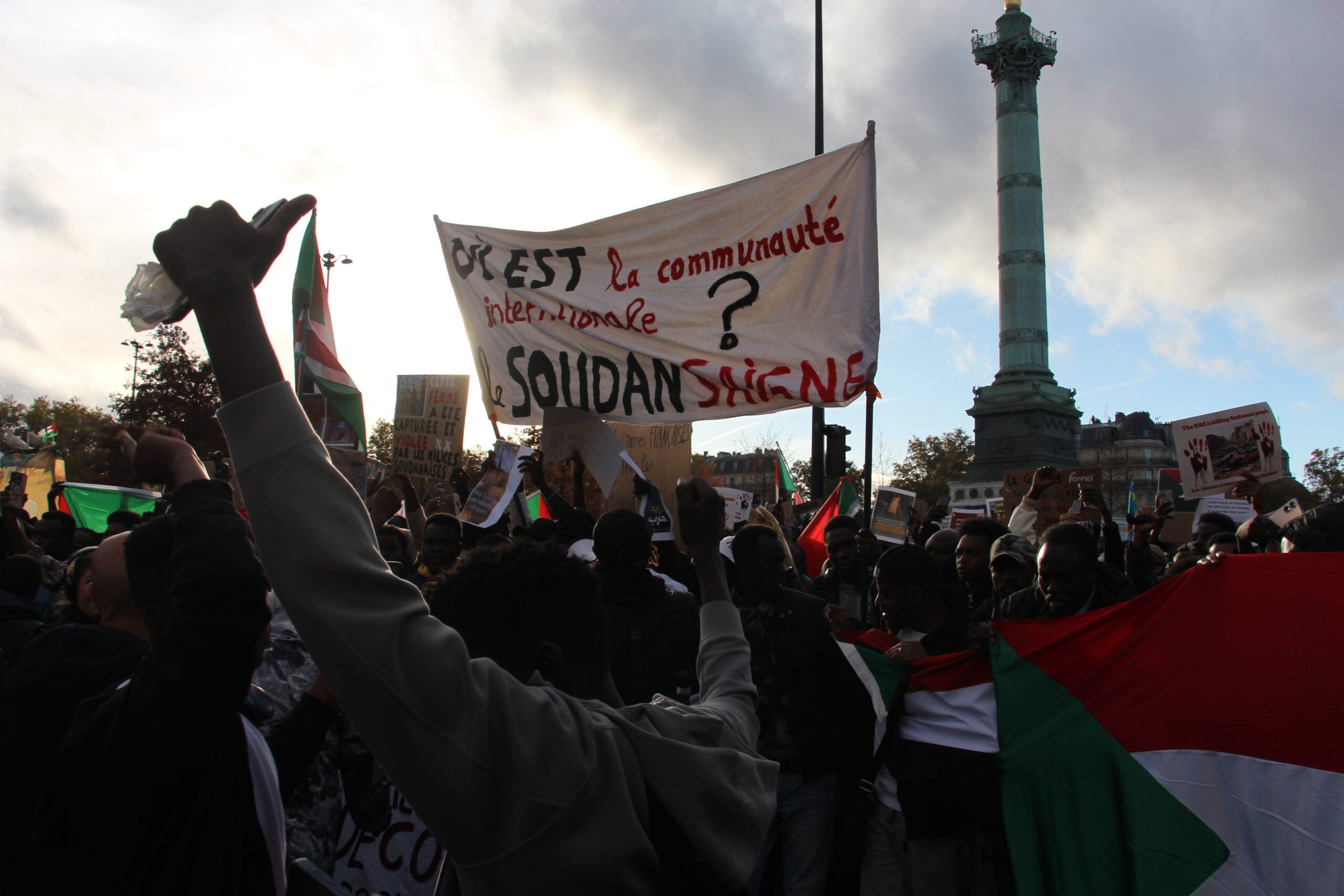
Image Credit: Manifestants contre le génocide au Soudan by ArtyElAnanas, CC BY 4.0, via Wikimedia Commons
_-_2025-11-01_-_6.jpg)