
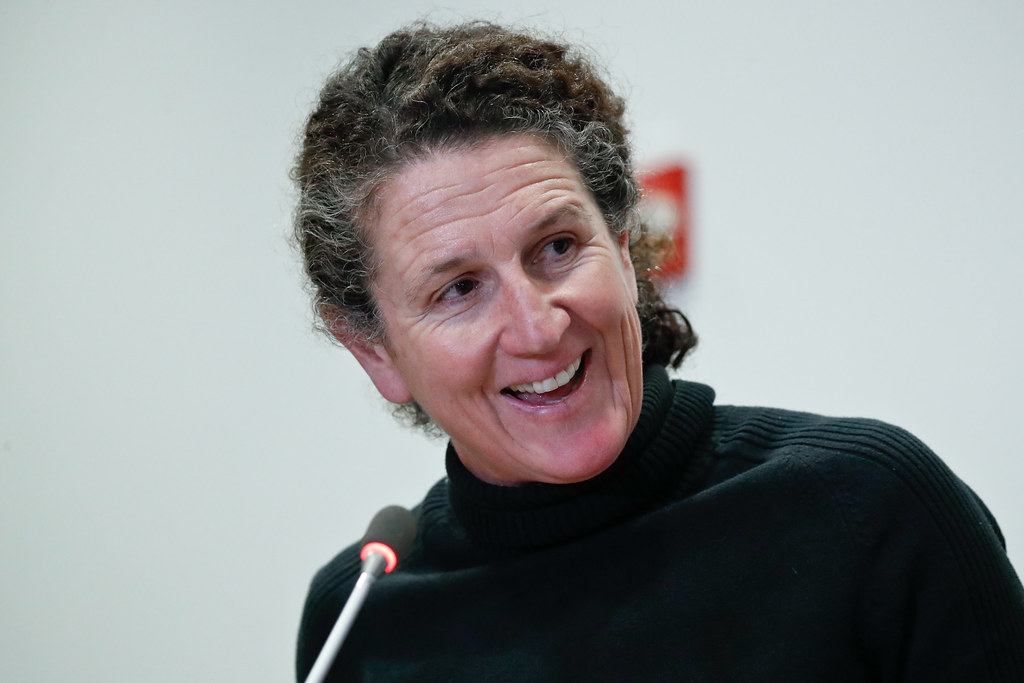
Dr. Jeni Klugman on COVID-19’s Toll on Women and the State of Gender Equality
In 1995, tens of thousands of activists gathered in Beijing for the Fourth World Conference on Women to develop a framework to advance gender equality. In light of the conference’s 25th anniversary, The Georgetown Institute for Women, Peace and Security (GIWPS) published Beijing+25: Accelerating Progress for Women and Girls to reflect and provide a roadmap to advance gender equity. GJIA sat down with Dr. Jeni Klugman, managing director of GIWPS, to discuss the report, including new challenges for women in the era of COVID-19.
GJIA: The Beijing +25 report mentions how COVID-19 is worsening gender inequality in the labor market. Why are female workers disproportionately impacted, and how has this played out globally?
JK: We have seen disproportionate impacts all around the world arising for several reasons. On the one hand, women are on the front lines in many of the jobs that they hold. For example, about eighty percent of healthcare workers are women. Many women work in frontline jobs like retail, supermarkets, and so on, which are subject to larger health risks in terms of infection. But on the other hand, they are also working in occupations which have been disproportionately affected by shutdowns and are often in positions which are unable to be done remotely, which have led to larger numbers of redundancies and layoffs. Combined with the widespread closure of schools and childcare in many countries means that the care needs at home are much larger than in the past. There are surveys from the United States, United Kingdom, and elsewhere showing that women are carrying the bulk of child care and home responsibilities, which is the case in normal times. But in these abnormal times, particularly with the closure of schools and childcare, means that it is very difficult to juggle and sustain.
If you look at the most recent figures just for the United States, for example, between August to September, around one million Americans withdrew from the labor force, of whom 800 thousand were women. Women are dropping out at approximately four times the rate of men. This is obviously a concern in the short term, but it is also a concern in the long term because labor economists have looked at previous recessions and episodes where withdrawal from the labor force can have longer-term repercussions because it is more difficult to re-enter. You not only lose your current earnings, but you also lose experience and the opportunities to advance. There are a whole host of reasons to be very concerned about this.
You mentioned how this is not only a short term employment loss, but there are a whole host of long term implications. Could you further elaborate on how this loss of employment might actually stunt development for women?
The inability to enter the labor market, initial job loss, and being forced to go part-time are all things which can have negative implications for career progression and earnings as well. These are the immediate impacts. But if you look at a graph, you can imagine slow expected growth of earnings over time, but you can see a whole reversal of that. It will eventually resume again, but what you have lost in the time being is unlikely to be fully reversed. You will end up behind in the long term.
Are there any countries which you would say are doing a good job stabilizing this disproportionate impact on women?
There was a good example from Australia (where I am from), where in March they introduced free child care and kept all the child care centers open. That was an important move that clearly removed the cost barriers, which can be prohibitive, particularly for lower-income workers. It is important for families, but it is particularly important for women for the reasons we have discussed. However, that ended in July or August. It was not a permanent change; it was a temporary one.
I have not actually seen this challenge being well addressed elsewhere, although one might well expect that there are innovations or at least experiments taking place which allow for some degree of coping. Some employers have become more flexible by allowing people to work remotely. But when you have the balance of care at home falling on women, without the underlying changes and norms and arrangements for that at home, it is very difficult for employers to directly address it.
What recommendations would you give to the US government or other governments around the world as to how to better address this issue because it is so rooted in cultural norms. What could the government do better in order to lessen these structural inequalities?
I think affordable childcare is key—I would put that at number one on the list. I would also encourage employers to think about ways to make work flexible, both in terms of hours as well as location, in ways that do not assume that it is only going to be women who are taking that up. Male leaders and managers within organizations need to demonstrate that it is possible to work part-time or balance care responsibilities in ways that do not lead to prejudice or worsened prospects. But I think the number one priority on this has to be affordable childcare and extended daycare as well. Some schools finish relatively early in the afternoons, which could mean that women are expected to be working part-time to be able to care for them. So having good quality, affordable care is very much at the top of the list.
The report also mentions how COVID-19 not only has worsened gender inequality in the labor market, but it has also facilitated a “shadow pandemic” due to spikes in violence against women. Could you further elaborate on how this shadow pandemic has manifested and to what extent it is affecting women?
Indeed, there were early reports and continuing reports about spikes in violence. One can see how that might come about because of the combination of increased stress, rising levels of poverty, household financial concerns, as well as the fact that people being cooped up together leads to increased risks of violence. The risks of violence are always there, but the underlying factors are amplified in the context of COVID lockdowns. Added to this is the concern that women and their families may not have anywhere to go, and it may be very difficult to report, leaving people in very difficult circumstances.
There are some interesting innovations taking place with new forms of hotlines and texts being run by various civil society organizations. There are some interesting examples from Europe about codes and sign language being introduced so that people could use them when they are out in public to signify that they are under threat without necessarily using their phones. This is because, in some abusive relationships, women either do not have their own phones or do not have control of them, so it can be risky to use them to report violence. Another important aspect relates to the response of the justice system. While many courts have closed down, it is important that they still be in a position to issue protection orders and interim orders to ensure the safety of women and their families when they are under threat.
I think it is important to look at the range of different dimensions, economic, social, political justice and security. There is no single dimension which fully captures the situation of women and girls around the world.
– Dr. Jeni Klugman
Let us shift towards the big picture. In your view, how well has gender equity progressed or regressed in the past twenty years since the Beijing 1995 conference? What are some of the biggest factors that have contributed to this progression or regression?
It is difficult to make a simple bottom-line assessment. Clearly, there has been progress in some areas like education, some aspects of sexual and reproductive health, and reductions in fertility. The opening up of economic opportunities in a number of countries, increasing engagement and effectiveness of civil society, and collective voices have all been important advances. On the other hand, violence is still pervasive, and women are still mainly doing stereotypical low paid occupations in too many places. The glass ceiling is still in place; fewer than about five percent of CEOs are women.
I think it is important to look at the range of different dimensions, economic, social, political justice and security. There is no single dimension which fully captures the situation of women and girls around the world.
I also think it is very important to focus on the needs and constraints of the most marginalized women, like those who are poor, who come from ethnic or sexual minorities, and so on. While things may get relatively equitable for women coming from more privileged backgrounds, there are a whole host of barriers facing women, particularly poor and minority women. Actually, in the more recent report that we published for the US Women, Peace, and Security Index, we documented the barriers facing African American and Latina women in the United States.
Overall, I think we are in a time of significant change. There is probably less progress than one might have expected, but it means that we have to continue to focus to advance the agenda to accelerate progress.
Over the past couple of years, there has been a sharp rise in strongman politicians from the United States, Philippines, to even Poland. How large of a threat do they pose to women’s advancement?
I think it is very significant. We also have more general backlash, which in some cases these strongmen are reflecting. There are certainly legislative reversals. For example, in the United States, limiting access to reproductive health and abortion services is a real diminution of women’s choice and agency. In other countries as well, there have been direct actions with major repercussions. I think symbolically as well, in terms of the atmosphere and culture, it sets an extremely bad precedent. I think we are all looking for role models, particularly for the young, to set an example on behavior, language, etc without necessarily mimicking them. Those which are being constantly breached in public life and by national leaders are a real threat.
What are your recommendations to female activists on the ground or policymakers who are trying to advance gender equity?
Keep up the great work! Look for tangible areas of progress. Women activists are doing a whole range of things, like providing direct services, supporting others, working in advocacy, and policy reform. All of those are very important.
One suggestion would be to consider the potential for coalitions and for broader groups to create change. The other thing I would say is to include diverse voices as well; so in the United States, bringing together racial and gender justice is very important and very powerful. Think about the commonalities and the synergies across the genders, so it is not just seen as a women’s issue.
Is there anything else you would like to share or any other recommendations that you want people to know?
I would certainly encourage people to glance over the report if they are interested. I think it provides quite a good synthesis of both progress as well as what needs to be done. And for anyone who is interested in the United States, in particular, a more recent US Women Peace and Security Index estimating the status and rights of women for all fifty states plus Washington DC, as well as racial and other angles, is an interesting thing to read.
. . .
Dr. Jeni Klugman is Managing Director at the Georgetown Institute for Women, Peace and Security. She is currently a member of The Lancet Global Commission on Gender and Health and advising VicHealth, Australia to bring behavioral insights to advancing gender equality. Dr. Klugman’s previous positions include Director of Gender and Development at the World Bank, fellow at the Kennedy School of Government’s Women in Public Policy Program at Harvard University, and director and lead author of three global Human Development Reports published by the UNDP.