
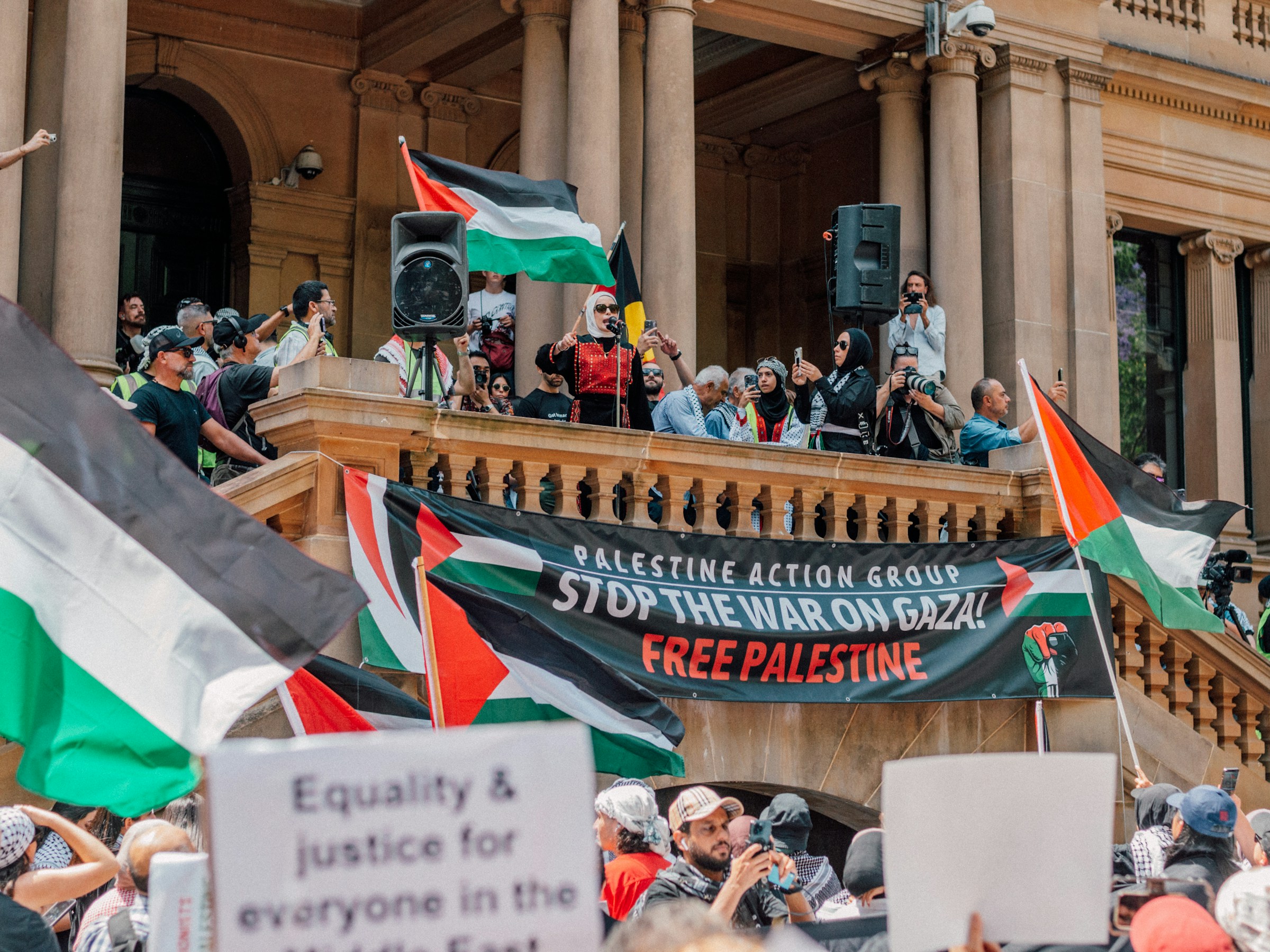
The Shrinking Space for Public Protest: Examining the United Kingdom’s Proscription of Palestine Action
This piece examines the UK government’s proscription of Palestine Action under the Terrorism Act, situating it within a broader trend of shrinking space for public dissent. It argues that the criminalization of direct action and solidarity with Palestine reflects an escalating strategy of political policing and censorship, raising profound questions about civil liberties, democratic accountability, and the right to protest in the UK and beyond.
Introduction
Since the events of October 7th, 2023, the global solidarity movement for Palestine has grown dramatically, drawing fracture lines between Western governments and an increasingly awakened and enraged populace. Palestine has become a litmus test; it is the defining political issue for many, especially young and first-time voters, who refuse to accept the financing and political inoculation of the Israeli state as it continues its genocide and settler colonial mission in Gaza and across the West Bank.[1]
In the UK, as the solidarity movement has grown, so too has the state’s monitoring, censorship and suppression of those involved. Public protests have been met with repressive and restrictive measures, such as the heavy-handed policing of public protest. The current Labour government has inexplicably sought to delegitimize and criminalize those involved in direct action—it proscribed Palestine Action as a ‘Terrorist’ Group in the UK. Established in 2020 with the aim of shutting down Elbit Systems—the Israeli arms company that operates in the UK—Palestine Action uses the strategy of direct action to disrupt and sabotage the Israeli arms industry and expose the UK government’s complicity in it. Since its establishment, Palestine Action has conducted direct action interventions targeting companies that either manufacture or finance Israeli military operations. These acts are designed to provoke media coverage, public debate, and force legal proceedings to ensure the situation in Palestine remains present in the public discourse.
Whilst political policing, criminalization of public dissent, and the shrinking of space in which to engage in protest are charges that have long been levied against successive UK governments, Palestine solidarity work over the past two years has been met with unprecedented levels of surveillance and criminalization, all whilst the government chose to maintain its historical support of the Israeli state and strengthen its partnerships through enhanced military aid packages and extensive intelligence sharing.
Already before the UK government’s proscription of Palestine Action, more “informal,” everyday tactics have been used to marginalize and delegitimize solidarity with Palestine across a variety of sectors. In workplaces, schools, universities, and cultural institutions, a discourse around “safety concerns” has become hyper normalized when it comes to attempts to manage the fallout from criticism of the actions of the Israeli state and the UK’s complicity in the genocide in Gaza. The resultant self-policing and self-censorship is evident amongst many individuals forced to weigh their solidarity with Palestine against fear of workplace ostracization and potential disciplinary action. For some, loss of employment due to expressing solidarity with Palestine has become a reality. High profile instances of legal cases and police arrests of a number of NHS doctors, lawyers, and academics provide ample evidence of a highly repressive environment.
The labelling of the solidarity movement for Palestine as a threat to public order, to British values, to democracy, as well as specific accusations of “hate” and “antisemitism” levied against individuals and groups that firmly stand in opposition to the genocide perpetuated by the Israeli state became routine. And yet, the decision of the home secretary to proscribe the direct action group Palestine Action is a worrying outlier and an escalation of an already problematic trend.
The Proscription of Palestine Action
Despite the overwhelming support the proscription of Palestine Action received in the House of Commons, the decision has generated much controversy across different sectors of UK society, as well as internationally. These criticisms include statements made by the Trades Union Congress (TUC), Amnesty International, Liberty, and the UN human rights commissioner. In October 2025, Matt Kennard from Declassified UK revealed that senior members of MI6 were also against the decision to proscribe the group under the terms of the Terrorism Act, arguing that it distracts the police from dealing with real terrorist threats. The invocation of the already controversial Terrorism Act thus seems to be a grossly disproportionate response from the UK government, opening up a range of potential legal pitfalls, all of which were debated during the Judicial Review in the UK high court late last month.
One of the requirements of the proscription order on the group was the shutdown of its website, an online space that provided details on the complicity of various UK-based companies in the genocide in Gaza and Israel’s military operations across the West Bank. In addition, the decision to proscribe could have a detrimental effect on the ongoing legal proceedings of those members currently on remand, imprisoned awaiting trial for their alleged involvement in previous direct actions. The decision to designate Palestine Action as a terrorist group not only criminalizes membership of those involved directly but also targets the many who have subsequently (and outwardly) expressed their support for the group. Therefore, under the existing proscription, anyone expressing their support by wearing a Palestine Action T-shirt, sharing a social media post, or even speaking out in favor of Palestine Action (perhaps by holding a sign that expresses as much) is liable for arrest. Political speech itself is being criminalized, with those expressing support for direct action being labelled as supportive of ‘terrorism’.
Fighting Back
Nevertheless, there has been pushback from several civil liberties groups, including the organization ‘Defend Our Juries’. Formed in 2020, Defend Our Juries is an activist group that advocates for the right of activists to be allowed to stand trial by jury, rather than being tried in front of a judge only, based on the principle that juries are more readily inclined to acquit people for acting on a matter of conscience. Following the proscription of Palestine Action, the group launched the ‘Lift the Ban’ civil resistance campaign, in order to challenge the proscription order and spotlight the extremity of the UK government position on Palestine Action. In inviting potential participants to publicly defy the proscription order and to openly declare their support for Palestine Action, the group was relying on the fact that such actions could ultimately lead to their arrest under the Terrorism Act. The stated goal is to ‘expose the absurdity and Orwellian nature of the ban’ by forcing the police to arrest a high number of non-violent protestors, flood the legal system with cases, and make the ban unworkable, ultimately forcing the government to change direction.
Since coming into effect on July 5, 2025, over two thousand people have been arrested under the Section 12 of the Terrorism Act 2000 for holding signs containing seven words: “I oppose genocide, I support Palestine Action.” Most of those arrested during such actions are older, middle-class, white British citizens. The organizers actively discourage those in precarious immigration, employment, or financial status from taking part in actions that would expose their vulnerability. Consequently, it has been much more difficult for the media to portray these types of activists as “terrorists” or even as “troublemakers.” Those who have been arrested include former vicars, doctors, teachers; many of them, by virtue of their perceived social status, are far less likely to face police violence or harsh sentencing. By stepping forward, their aim is to protect more vulnerable activists, particularly those who have long faced harsher treatment during such protests, namely Palestinians, Muslims, and people of color. They have routinely received far greater police attention, leading to heightened exposure to the UK legal system and stigmatization in the court of public opinion. This is a powerful weaponization of privilege, and the public support for these actions is high.[2]
Why suppression?
This invariably begs the question—what is it that Palestine solidarity work truly threatens? Why has Palestine Action evoked such a draconian, violent, and lawfare-driven response from the UK government? The answer lies in the fact that Palestine Action has been successful in exposing the level of the UK government’s complicity in genocide. In exposing high-level partnerships between companies that stand accused of fueling the Israeli war machine, Palestine Action has directly linked the UK government to the charge of aiding and abetting a plausible case of genocide—as per the verdict reached by the International Court of Justice in 2024. In labelling their actions as “terrorism,” the UK government has invoked significant levels of stigmatization and legal overstretch to prevent further exposure of its complicity in the ongoing genocide in Gaza.
More broadly, the intensity and comprehensiveness of the process of repression and criminalization of Palestine solidarity activism in the UK (and elsewhere) is part of a broader systemic oppression linked to the maintenance of global racial capitalism, a point that Adam Hanieh has previously argued. The overwhelming support provided by most Western governments, including the UK, for Israel’s ongoing genocide can be explained when understood as reflective of their desire to protect and maintain their material interests in the region, given the Middle East’s centrality to the global oil economy and Israel’s role in maintaining it. The use of a variety of tools to silence and shut down dissent, including the invocation of highly controversial legislation such as the Terrorism Act, and ultimately, in proscribing those who disrupt these Western interests as “terrorists,” is yet further evidence of the extreme measures the UK government is willing to take in order to maintain unequivocal support for the Israeli settler colonial state and its expansionist project in historic Palestine. The tactics employed by the UK state when it comes to the suppression of Palestine solidarity work reflect the fact that it represents a major threat to the status quo, and as a result it is subject to suppression, stigmatization, criminalization and attempts to have it quashed.
Whilst it is difficult to make policy recommendations in a piece that is fundamentally spotlighting the highly problematic role that the UK Terrorism Act is playing when it comes to targeting pro-Palestine work (alongside other forms of protest that threaten the status quo, including climate justice activism and migrant solidarity) the most just and reasonable policy change would be a full revocation of the Act itself which, alongside the UK’s highly controversial Prevent strategy have been long accused of being Islamophobic. As for civil society actors and organizations involved in struggles for social, political, historical and climate justice, this article calls for the strengthening of existing alliances, as well as the building of new ones, both local and transnational. Such alliances are necessary to confront the growing authoritarian tendencies of regimes around the world in their attempt to suppress and silence any threats to the existing order of racialized exploitation, dispossession, austerity and colonialism in its different manifestations.
[1] The discussion on Palestine as/and settler colonialism is found at the center of many academic works, including Zurayek (1956), Sayegh (1965), and Abdo and Yuval-Davis (1995), and more recently through the work of Wolfe, (1999; 2006), Salamanca et al, (2012), Masalha, (2012), Shlaim, (2012), Lloyd, (2012), and Hawari, Plonski & Weizman (2019), among many others.
[2] Mandy Turner and Elian Weizman, ‘We oppose genocide, we support Palestine Action!’, Resisting the criminalisation of anti-genocide dissent in the UK’, in: Resisting Criminalisation: tactics of repressions, tactics of struggle, edited by Koshka Duff, Chris Rossdale, Federica Rossi and Elian Weizman, Forthcoming 2027, Bristol University Press.
. . .
Elian Weizman is a Senior Lecturer in International Relations at London South Bank University. Her recent work focuses on the criminalization of political activism and dissent in the State of Israel, and the criminalization and repression of Palestine solidarity activism in the UK.
Brendan Ciarán Browne is Associate Professor of Conflict Resolution, and Fellow of Trinity College Dublin. His recent work includes analysis on the impact of transitional justice in the context of Palestine and comparative reflections legacies of colonialism in the context of Ireland and Palestine.
The views expressed in this article are solely those of the author and do not necessarily reflect the views of the Georgetown Journal of International Affairs, Georgetown University, or any of their affiliates.
Image Credit: Nikolas Gannon, Unsplash Content License, via Unsplash