
Title: The War Against Iran and Global Risks: “Tell Me How This Ends”
The 2026 U.S.–Israeli strikes against Iran, initiated under Operation Epic Fury, represent one of the most consequential military interventions in recent Middle Eastern history. This article examines the war’s multidimensional consequences across national, regional, and international arenas and finds that the structural constraints of such a conflict risk the intervention’s transforming into a strategic overextension for the U.S. To avoid such an outcome, the article argues against any escalatory action and recommends that U.S. policymakers prioritize diplomacy over prolonged war. In a conflict defined by uncertainty, the most prudent course for U.S. policymakers is to pursue strategies that carefully manage escalation and reduce the risks of a wider regional and global crisis. By combining multilateral engagement and strengthening regional security partnerships, the U.S. could minimize the risks of a long-term ground war and strategic overextension.
Introduction
The 2026 U.S.–Israel war against Iran has challenged the fundamental realities that have dictated the last few decades of Middle Eastern history. It has disrupted Iran’s internal power dynamics and raised critical questions about regional stability, global energy security, and transnational terrorism. The beginning salvo, U.S.-Israeli joint strikes that took place on February 28, specifically targeted leadership, military installations, and missile production sites. Yet, despite President Trump’s outlining four clear military objectives for what was named “Operation Epic Fury,” those being preventing Iran from acquiring a nuclear weapon, destroying missile sites, degrading proxy networks, and annihilating its navy, the ultimate objective appears to be the systematic degradation of the Iranian government.
In the context of the outlined objectives, the immediate military strikes appear rational. This conflict may very well have postponed a nuclear threat. While the nature of the intelligence that spurred such action remains classified, what is certain is that the operation has substituted any imminent threat with immediate instability, with unknown ramifications. Indeed, various possible consequences of the war include, but are not limited to, escalating asymmetric retaliation, further proxy conflicts, an escalation of cyber warfare, and economically crushing maritime disruptions. The range of potential consequences across domestic, regional, and international arenas, combined with an unclear end goal for the U.S. and Israel, underscores the need for policymakers to fully understand the context that defines the conflict and its belligerents, and to carefully navigate policy decisions in such an uncertain setting.
To that end, this article will examine the domestic, regional, and international context of the war, demonstrating how the confluence of these influences constrains possible U.S. policy in culminating the current campaign with an achievement of objectives. It will conclude with recommendations for U.S. policymakers on the most prudent path forward in de-escalating what could very well be the seminal conflict of the decade. It is impossible, of course, to predict the future. However, it is exactly that uncertainty—uncertainty which has by no means been decreased over the course of the war—which highlights the need for the U.S. to reconsider its path.
A Destabilized Iran: Divided Politically and Ethnically
The death of Iranian Supreme Leader Ayatollah Ali Khamenei and the selection of his son, Mojtaba Khamenei, to fill the role have created an unprecedented leadership shift in Iran. Over the last four decades, the office of the Supreme Leader has centralized power through the Iranian Revolutionary Guard Corps (IRGC), securing authority to decide all critical matters of domestic, military, and foreign policy. Institutionally, the strength of the Supreme Leader has served as a mechanism of authoritarian stabilization in Iranian internal politics, limiting factional competition that might otherwise destabilize a nominally unitary regime. As Khalaji notes, since 1989, “the Supreme Leader has tightened hardliner control over management of the Shia clerical establishment,” illustrating how centralized authority constrains elite autonomy and maintains regime cohesion. The death of Supreme Leader Ali Khamenei on February 28, 2026, has disrupted the institutional balance in Iran, heightening uncertainty and prompting surviving elements of the regime to intensify security measures and reinforce elite cohesion in efforts to maintain stability. These conditions open the possibility of a highly militaristic regime that relies more explicitly on force, especially in the absence of the mediational authority and legitimacy that the Supreme Leader provides. Regardless of regime efforts to calcify control, Iran now faces a higher risk of entering a transitional phase contested by disagreeing domestic factions.
As evidenced by recent domestic turmoil, public sentiment in Iran has grown increasingly polarized. On one hand, right-religious-leaning populations perceive the killing of Khamenei as an insult to the symbol of Shia religious authority, as thousands of Iranians gathered in squares to mourn his loss and seek revenge against the violent removal of their leader. On the other hand, reformist-leaning groups have celebrated the killing of Khamenei worldwide. Thus, some reformers support the return of exiled Prince Reza Pahlavi, and people were heard shouting “Javid Shah!” — “Long live the shah!” showing their support. Pahlavi presented himself as a secular leader who could steward the country through a transition to secular democracy in Iran, carefully guiding Iran out of its post-1979 revolutionary order through constitutional reform and reintegration into the international community. However, with President Trump expressing skepticism that Reza Pahlavi could run Iran in the future and stating that someone already within Iran “would be more appropriate,” others have considered domestic alternatives. Yet, no such consensus political figure exists, complicating the organization of domestic opposition around a coherent movement.
This polarization reflects the complexity of public opinion in Iran. The opposition’s struggle to unify around a coherent vision for the post-uprising future intensifies the risks of regime change. Beyond political alignment, Iran’s population is ethnically diverse, with Persians as the majority and significant Azeri, Arab, Kurdish, and Baloch communities, the latter of which have histories of political tension and insurgency. The resurfacing and exacerbation of ethnic divisions in the existing context of foreign attacks and political division increases the likelihood of warring ethnic states emerging should the Islamic Republic collapse. In the absence of a figure that can bridge the political and ethnic divides, any path that sees existing institutions devastated promises instability.
Any collapse would be devastating. Such an outcome would certainly fuel a new international refugee crisis. The European Union Agency for Asylum warns that if just 10 percent of Iran’s population fled, this would rival the largest refugee flows of recent decades.” European borders could face unprecedented migration pressure, which could strain neighboring states like Turkey and Iraq, turning the conflict into a broader humanitarian crisis.
Regional Implications: Increased Gulf Cooperation and Further Proxy Warfare
At the regional level, the conflict has revealed the extent to which Iran can engage in asymmetric warfare with adversaries. Iran has launched missile and drone barrages against Israeli territory, U.S. military bases stationed in Gulf states, including Bahrain, Kuwait, Qatar, and the United Arab Emirates, and critical civilian infrastructure in those aforementioned states, resulting in casualties and widespread societal disruptions. Even with its conventional capabilities severely diminished, with the Islamic Republic of Iran Navy devastated, Iran has leveraged cheap and expendable drones to export the cost of war to neighbors, and economically, to the West writ large. The U.S.’s ability to reactively respond to these attacks relies on expensive air defense systems, and any proactive attempt to dismantle such Iranian capabilities would either require the deployment of significant ground forces or simply prove impossible. A continuation of the existing dynamic of engagement will thus impose far greater costs on the U.S. than on Iran.
Iran has also broadened and escalated the war through its network of allied militias (the axis of resistance), such as Hezbollah in Lebanon, Shiʿa militias in Iraq, and the Houthis in Yemen. The existence of such groups across the region, violence in the region, necessitates that the U.S. and Israel divert attention towards other, diffuse fronts. For example, Hezbollah’s launching rocket attacks out of Southern Lebanon on March 2 pushed Israel to expand a nationwide air campaign across Lebanon, striking Beirut’s southern suburbs, the Bekaa Valley, and southern towns such as Nabatieh and Tyre. Regardless of locality, engagement with such decentralized groups proves costly, as exemplified by 2025 operations against the Houthis costing $1 billion in three weeks. The possibility of a Houthi entry into the conflict or the expansion of militia operations in Iraq thus risks spreading resources thinner and expending them at a far faster rate.
The war’s most discussed impact has concerned the impact of asymmetric engagement on the safety of energy infrastructure and disruptions at the strategic Strait of Hormuz. Since the initial U.S.-Israeli strikes, Iran has imposed the cost of conflict on the U.S. by damaging the transit of oil through the Strait, causing oil price spikes and higher shipping insurance costs. Disruptions have led to skyrocketing energy costs, which have reverberated through the global economy and will continue to do so with increasing intensity. The Houthis, possibly following a similar path in the Strait of Mandeb, further threaten to damage adversaries’ economies. Ultimately, with global markets heavily reliant on cheap energy for growth, either continuously neutralizing diffuse threats against critical infrastructure and transit points or bearing the economic impacts of resulting disruptions remains unsustainable.
Global Implications: A new frontier of conflict
Despite intensified operations, the U.S. remains engaged in critical defensive posturing across the Indo-Pacific and Eastern Europe. With the U.S.’s principal adversaries in those regions, Russia and China, respectively, condemning the operation in Iran and finding opportunity in the divestment of U.S. forces from their theaters, prolonged engagement with Iran risks shifting balances of power in their favor. Russia most clearly emerges as a winner as this war continues, draining supplies that Ukraine needs. Kyiv now faces a shortfall of missile interceptors, long provided by the U.S., allowing Russia to rebolster its air operations. The conflict has also diverted U.S. and allied diplomatic attention from Ukraine, reducing international pressure on Moscow as exemplified by the U.S. reduction of sanctions on Russian oil exports in an effort to lower energy prices. Surging oil prices and increasing export quantities have boosted Russia’s economy as a major energy exporter and strengthened its capacity to fund military spending. In terms of equipment and sanctions policy, the pursuit of objectives in Iran has entailed trade-offs in engagement with Russia. A strengthened Russia’s alignment with Iran could also transform the conflict into a wider proxy confrontation. Russia could respond indirectly by carrying out cyberattacks on Western infrastructure, causing financial disruptions—thereby raising the strategic and economic costs of U.S. action—and Russia’s providing Iran with intelligence to target U.S. forces could increase chances of catastrophic U.S. casualties.
China, too, remains deeply invested in the Islamic Republic’s survival as Iran’s ally and the largest buyer of Iranian oil, purchasing up to 80%-90% of Iran’s exported crude, and stands to benefit from a diversion of U.S. forces. Iran is a key component of the regional order that Beijing has invested billions in establishing. The war in Iran poses significant challenges to China’s energy security and regional influence and, as such, invites Beijing’s involvement. To ensure the survival of its ally, Beijing has continued to provide military supplies, particularly rocket parts, to Iran, and, despite the lack of overt actions against the U.S., provided intelligence and economic aid to Iranian war efforts.
Excessive U.S. investment in a Middle Eastern war risks recreating the very strategic overextension that has historically limited Washington’s ability to focus on great-power competition. While the U.S. could weaken a key pillar of Beijing’s Middle Eastern network by securing a more Western-aligned Iran, the process of engagement provides an opportunity for Beijing to address its own geopolitical challenge: Taiwan. The operation has required diverting American military resources, political attention, and logistical capacity from the Indo-Pacific theater, weakening U.S. defensive capabilities in the Western Pacific. For instance, the U.S. has shifted major military assets, including aircraft carriers and Marine personnel, toward the Middle East amid the war against Iran to strengthen operations around the Strait of Hormuz, diverting forces that might otherwise be available for deterrence in the Western Pacific. This change has raised concerns in Asia about a perceived distraction from China, as the Iran war leaves Japan and South Korea on edge, and Taiwan’s contingencies.
By limiting the scope and length of its engagement, the U.S. can avoid this deterioration in capabilities and prevent China from gaining an opening to wrest control of Taiwan without facing opposition from U.S. forces. However, this task becomes more difficult if Beijing and Moscow continue supporting Tehran, potentially strengthening Iran’s resilience and prolonging the conflict.
Policy Recommendations
The war against Iran illustrates how military intervention in a complex and highly securitized state can rapidly evolve into a protracted and multidimensional conflict involving proxy warfare, cyber operations, maritime disruptions, and economic shocks. Such domestic, regional, and global dynamics risk transforming a limited operation into a broader regional confrontation with global implications. In understanding and operating within these constraints, U.S. policymakers must pursue strategies to achieve objectives that avoid the pitfalls of large-scale ground war.
First, the U.S. must pursue a multilateral containment and engagement strategy with stabilization measures. It can most successfully do so by coordinating diplomatic pressure with institutions such as the International Atomic Energy Agency (IAEA) and the UN Office for Coordination of Human Affairs (OCHA). In conjunction with existing regional frameworks such as the Gulf Cooperation Council (GCC), these partners can ensure more effective and better legitimized monitoring of Iranian activities, enforcement of ceasefire arrangements, and establishment of humanitarian corridors. As effective deterrence in today’s globalized world requires multilateral support rather than unilateral action, it could allow the U.S. to downscale its operations and constrain Iranian military recovery and retaliation. Embedding U.S. foreign policy within a multilateral framework would also diminish the chances of internal collapse and reduce the risks of a prolonged war involving proxy engagement by other global powers.
Second, the U.S. should establish a dedicated regional defense security framework, similar to the Middle East Defense Organization (MEDO) proposed by the U.S. and UK in 1951, to counter regional threats. Regional security partnerships can align and enhance the defensive capabilities of Gulf States, which currently live under persistent Iranian missile and proxy threats. Such a distributed security strategy model can bolster immediate defensive readiness, create a credible deterrent that complicates Iran’s operational calculations, and protect critical interests in the Gulf, while reducing the U.S.’s direct operational burden.
The United States should avoid a large-scale ground intervention. Lessons from Iraq and Afghanistan underscore the immense human, financial, and strategic costs of prolonged interventions, and a long war in Iran would likely overstretch U.S. military capacity, weaken its ability to defend allies and economic interests in the Gulf, and undermine credibility among partner states hosting U.S. military bases.
Conclusion
General David Petraeus, who oversaw coalition forces in Iraq between 2007 and 2008, asked, ‘Tell me how this ends.’ Petraeus’s question demonstrates that in the absence of a clear and achievable objective, military action risks triggering long and costly conflicts. In this context, wars must be judged by whether policymakers can realistically reach a stable and acceptable conclusion.
Petraeus’s question is doubly urgent today. While a short-term operation has succeeded in weakening Iran’s military capabilities, the broader question of what constitutes a successful end state remains unresolved. Without a clear off-ramp, the U.S. is risking Operation Epic Fury spiraling into a war without end. Furthermore, constrained by the confluence of Iran’s internal division, which is inconducive to a stable state should the current regime collapse, a regional context, which heightens the impact of the asymmetric combat that Iran holds great capacity for, and a global theater, which incentivizes U.S. adversaries to act in the absence of U.S. capacity elsewhere, the U.S. diminishes its own economic resources and capacity for action in continuing any degree of military engagement.
Overall, U.S. strategy should prioritize deterrence without occupation, protect maritime trade and energy routes in the Gulf, and establish credible de-escalation mechanisms with regional actors. Avoiding a prolonged ground war would also preserve U.S. strategic capacity to support Ukraine against Russian aggression and maintain deterrence in the Indo-Pacific in the event of a crisis involving Taiwan. Short-term operations may achieve tactical objectives, but long-term stability requires diplomacy, regional cooperation, and political legitimacy. Without such a balanced strategy, the risks of humanitarian crises, economic disruption, terrorism, and broader geopolitical escalation will continue to grow.
. . .
Dr. Widyane Hamdach is a professor of political science and UN programs coordinator at Saint Peter’s University. She earned her PhD in global affairs from Rutgers University, specializing in global governance, Middle Eastern studies, and international relations. With over 17 years of experience as a TV reporter and producer, she has covered international affairs at the United Nations for various media outlets. Dr. Hamdach is the author of the book Framing the War on Terror: Arab Media Perspectives and Geopolitical Realities (2026).
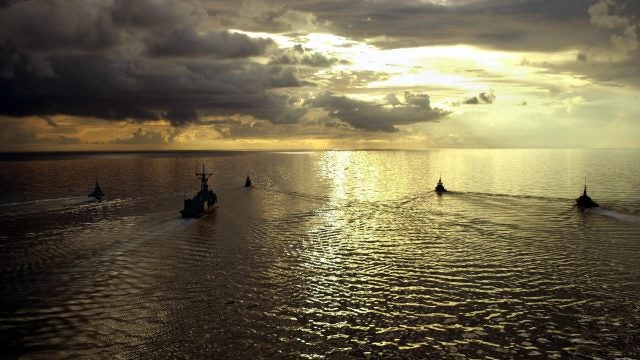
Image Credit: Frank E Petersen Jr Supports Operation Epic Fury by OptimusPrimeBot, PDM 1.0, via Wikimedia Commons
.jpg)
Recommended Articles
The existential dangers posed to Indo-Pacific sea lines of communication and, consequently, to regional economies by armed conflict cannot be overstated. This article argues that, despite this, the development of…

Critical maritime infrastructures (CMI), and in particular undersea communication cables, are increasingly under threat of attacks by malign actors who benefit from asymmetric capabilities and jurisdictional complexities in the maritime…
This article explores how the Palestinian crisis and the death of the two-state solution endangers the Hashemite Kingdom of Jordan. It illuminates the complicated relationship between Jordan, Israel, and Palestine…