
Short Pauses, Long Shadows: War-Legacy Aid and Vietnam’s Trust in U.S. Commitments
The Trump administration’s freeze on foreign aid and subsequent dismantling of USAID disrupted war-legacy programs in Vietnam that had served as the bedrock of U.S.-Vietnam reconciliation for three decades. This article examines how the disruption eroded trust in American reliability, reinforced China’s narrative of U.S. fickleness, and prompted Vietnam to accelerate its diversification of partnerships. For the U.S. to become a credible partner and retain this critical swing state, it must insulate aid programs from partisan volatility, multilateralize their funding base, and leverage them as strategic assets within the Comprehensive Strategic Partnership framework.
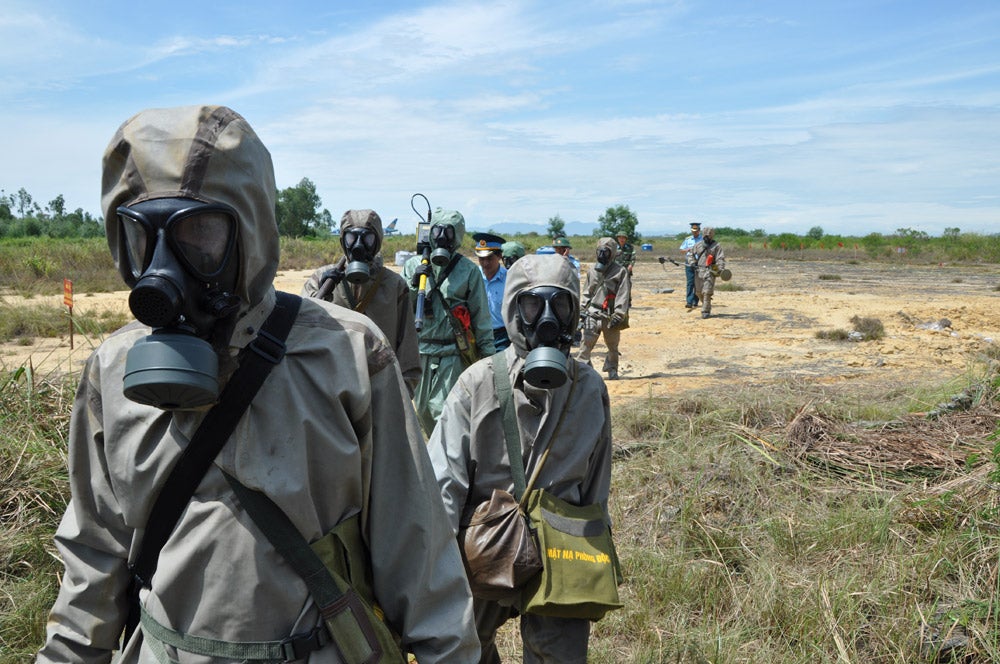
In mid-February 2025, as tarps blew off piles of dioxin-soaked soil at Bien Hoa airbase and demining teams across central Vietnam were sent home without pay, diplomats cabled Washington about the risk of an “environmental and life-threatening catastrophe.” The cause was not a new crisis in Southeast Asia but an executive order in Washington. President Donald Trump had frozen foreign aid and then dissolved USAID, abruptly suspending the war-legacy programs that had underpinned U.S.-Vietnam reconciliation for decades. Within days, the freeze idled more than a thousand deminers, cut off disability services for tens of thousands of Vietnamese, and reduced the world’s largest dioxin remediation project to a skeleton crew.
For the United States, war-legacy programs in Vietnam are rounding errors in foreign spending—a few hundred million dollars spread over many years. For Vietnam, in turn, addressing Agent Orange “hot spots” (sites of severe dioxin contamination, chiefly former U.S. airbases), unexploded ordnance (munitions that failed to detonate during the war), and victims of those remnants transcend mere development projects; they constitute a litmus test of whether Washington accepts a moral debt from the war and can be trusted to honor long-term commitments.
Although the funding pause was brief, the chaos it unleashed exposed how quickly modest policy shifts can unravel decades of carefully cultivated trust. Vietnamese officials have long viewed war-legacy cooperation as a foundational pillar of the relationship and a precondition for deepening defense ties, and Vietnam’s accelerated hedging—diversifying partners and deepening ties with Beijing, including its first-ever joint army drills with China in July 2025— following aid cuts revealed the fragility of the Comprehensive Strategic Partnership with the U.S. signed just eighteen months earlier. The freeze undermined the foundation of trust that decades of reconciliation had built, handing Beijing fresh evidence that American promises cannot survive a change of administration and weakening Washington’s position with one of the Indo-Pacific’s most consequential swing states. The question now is whether Washington can recover the moral authority and strategic advantage that war-legacy cooperation has provided or whether it ceded that narrative to competitors willing to exploit American inconsistency.
War-Legacy Cooperation as the Emotional and Strategic Core
Since the 1990s, the U.S. has provided Vietnam assistance to address unexploded ordnance (UXO), Agent Orange contamination, and missing Vietnamese soldiers from the U.S.-Vietnam War. From the early 1990s to 2025, Washington provided Vietnam with more than $250 million for UXO clearance and over $155 million for disability support in Agent Orange and UXO-affected provinces. In 2018, the two countries completed the $110 million cleanup of the dioxin hotspot at Da Nang Airbase and are now implementing a remediation project at Bien Hoa Airbase, the largest remaining dioxin hotspot.
Through these programs, Vietnam and the U.S. have transformed post-war issues from a source of recrimination into a foundation for bilateral relations. For example, cooperation on MIA search operations in the late 1980s created sustained channels of communication between Hanoi and Washington when the two countries had no formal diplomatic ties, gradually building the personal and institutional trust needed for normalization. In the decades that followed, these programs deepened reconciliation at both governmental and people-to-people levels. This collaboration eventually contributed to the establishment of the Comprehensive Strategic Partnership in 2023, Vietnam’s highest diplomatic designation for a bilateral relationship.
While security concerns over Beijing’s growing regional influence and Vietnam’s push to integrate into the global economy have driven the incremental recovery of U.S.-Vietnam relations, Hanoi sees American commitment to addressing war legacies as a prerequisite for deeper bilateral ties. Given the scale of destruction the U.S. inflicted during the war and the suffering that persists in Vietnamese communities today, Hanoi expects Washington to demonstrate sustained responsibility before trust can extend into more sensitive domains, particularly defense cooperation. For the U.S., involvement in war legacy projects serves a complementary strategic logic: it demonstrates good faith to a partner whose cooperation Washington increasingly needs on the South China Sea, supply chain diversification, and the broader contest for influence in the Indo-Pacific.
War-legacy cooperation has always been an asymmetric bargain. Congress appropriates hundreds of millions of dollars for projects with no immediate political payoff in the U.S. but with real moral and bureaucratic costs, while the benefits accrue largely to Vietnamese civilians. Precisely because these programs are politically costly for Washington yet indispensable for Vietnam, they function as a litmus test of U.S. seriousness. If America is willing to keep paying to clean up a war it lost half a century ago, Hanoi can more credibly believe that it will stand by newer, less emotionally charged commitments.
The 2025 Freeze: Disruption and Lingering Uncertainty
On January 25, President Trump issued an executive order halting all foreign aid for ninety days. The administration’s subsequent dismantling of USAID and takeover of USIP’s operations severely disrupted U.S.-funded humanitarian programs across Vietnam. Thousands of families affected by Agent Orange abruptly lost access to rehabilitation services. In Quang Tri Province, Vietnam’s most UXO-contaminated region, over a thousand local demining personnel found themselves out of work, and Vietnam’s Ministry of Foreign Affairs warned that suspended decontamination work created significant public health and environmental risks.
Vietnamese officials and influential American voices lobbied promptly for a reversal, and funding for most projects resumed by late March. Since then, the two countries have marked some milestones in their cooperation. Most notably, in October 2025, ahead of Secretary of Defense Pete Hegseth’s Vietnam visit, they signed a memorandum of understanding reaffirming their commitment to addressing war legacies across five areas: UXO clearance, disability support for provinces heavily affected by Agent Orange, dioxin decontamination at Bien Hoa Airbase, recovery and identification of Vietnamese soldiers’ remains, and American MIA accounting.
Still, uncertainty persists. Following USAID’s closure, the U.S. embassy absorbed responsibility for war-legacy programs, but the departure of experienced staff and the unstable status of USIP cast doubt on those projects’ continuity and quality. How Vietnam reads that uncertainty will determine whether the Comprehensive Strategic Partnership rests on solid ground or shifting sand.
Strategic Costs of a “Brief” Suspension
For Hanoi, the real danger of the 2025 freeze was not two months of lost work; it was what the disruption revealed about American staying power. On paper, the crisis was contained: programs resumed, in some cases with higher budgets, and senior officials on both sides reaffirmed their commitment to seeing the job through.
But the episode rewrote expectations in Hanoi. A start-stop pattern in the “safest” and most symbolically important area of cooperation signaled that any project could fall victim to swings in U.S. domestic politics. If an executive order can freeze Agent Orange remediation, few guarantees exist for more sensitive domains, such as maritime security cooperation, defense-technology transfers, supply-chain diversification, or restraint on punitive tariffs. When considered alongside Trump’s renewed tariff threats and his administration’s visible downgrading of multilateral engagement in Southeast Asia, this withdrawal signals that U.S. commitments, however solemnly framed, are unreliable.
That message plays directly into China’s narrative and strengthens anti-American voices within Vietnam’s elite. Beijing has long portrayed the U.S. as a fickle power that abandons partners once domestic priorities shift. The USAID saga offers fresh fodder for that claim. In April 2025, just weeks after the aid freeze and Trump’s “Liberation Day” tariff, Xi Jinping arrived in Hanoi for a state visit and signed 45 agreements covering supply chains, railway development, and emerging technologies. While Hanoi has not turned to Beijing for cooperation on war-legacy remediation, it has expanded high-level military engagement with China, including its first joint army exercise in July 2025. The aid pause allowed China to emerge as a stable partner in a season of American unpredictability and undermined decades-long efforts of pro-U.S. officials to sell closer ties with Washington as strategically useful and reliably managed. When the most tangible symbol of reconciliation is abruptly put at risk, advocates of deeper defense cooperation lose one of their strongest arguments.
This perceived American fickleness has also produced tangible impacts beyond China. Vietnam has intensified its recent efforts to diversify funding and partners for war-legacy work, courting Japanese grants for dioxin and UXO projects, Korean and UN Development Program support, and new European engagement, especially with Belgium. At home, Hanoi is moving to secure its own capacity: a new ordinance on postwar bombs and mines and the growing role of the Vietnam National Mine Action Center are meant to ensure that progress does not hinge on a single foreign donor.
The damage also extends into the broader region. For a decade, U.S. officials have held up war-legacy cooperation in Vietnam as the Indo-Pacific’s premier success story of post-conflict reconciliation—a model for converting historical enmity into strategic partnership. Now, that seemingly strong foundation is crumbling with ramifications across the Indo-Pacific. Beyond Vietnam, the aid freeze also disrupted similar war-legacy efforts in Cambodia and Laos. From Manila to Jakarta, the vulnerability of even this flagship case to the whims of a single U.S. administration feeds into the quiet, region-wide recalibration of how much risk governments are willing to run on American promises and of how they perceive Chinese counteroffers.
Policy Implications
The USAID scare in Vietnam is a gift—if Washington chooses to learn from it. A relatively small pocket of funding, devoted to an unglamorous mission, exposed a structural weakness in U.S. statecraft: the ease with which short-term political theatrics at home can derail long-term strategic investments abroad. For all the talk of U.S. commitments in the Indo-Pacific, allies and partners will judge Washington by whether it can sustain morally demanding, politically thankless commitments over time. Secretary of Defense Hegseth’s description of war-legacy cooperation as “a top priority” and “the foundation” of the defense relationship sets the right tone, but rhetoric must be matched by quiet, predictable funding that survives the next budget fight.
First, Congress should firewall war-legacy work from partisan swings. A workable precedent already exists: the U.S. President’s Emergency Plan for AIDS Relief (PEPFAR), created by the 2003 Leadership Act with permanent statutory authority and five-year reauthorization cycles, built a two-decade bipartisan consensus that endured the 2025 aid freeze. Parallel legislation—Vietnam War Legacies Act— should codify dioxin cleanup, UXO clearance, disability support, and MIA accounting as enduring obligations rather than discretionary aid. Funding should be set on five-year cycles to give Hanoi and implementation partners greater predictability, while any suspension should require congressional notification.
Second, Washington and Hanoi should translate that statutory foundation into an operational framework. A joint agreement should specify multi-year plans, funding commitments, and measurable milestones across the five pillars identified in the October 2025 MOU. A standing bilateral commission—comprising senior officials from defense and foreign ministries alongside NGOs and other partners—should convene at least annually to review progress and program future work.
Third, crucially, the commission should provide an entry point for third-party contributors—Japanese, European, and UN partners co-financing against shared milestones—while preserving the United States as anchor donor and convener. For Washington, this distributes cost, embeds allies in Indo-Pacific commitments that serve broader China strategy, and gives Hanoi political cover to deepen ties without appearing U.S.-aligned. Multilateralization extends American responsibility rather than diluting it.
If the U.S. wants Vietnam—and the wider region—to bet on its staying power, it must show that even when politics change in Washington, its promises do not.
. . .
Dr. Nguyen Khac Giang is a Visiting Fellow at the Vietnam Studies Programme, ISEAS – Yusof Ishak Institute. He was formerly Head of the Political Research Unit at the Hanoi-based Vietnam Institute for Economic and Policy Research (VEPR). He holds a PhD in Political Science from Victoria University of Wellington, New Zealand, and is a frequent commentator on Vietnamese affairs.
Phan Xuan Dung is a PhD candidate in International Relations at the Australian National University’s Coral Bell School of Asia-Pacific Affairs and a Research Officer at the Vietnam Studies Programme, ISEAS – Yusof Ishak Institute. His academic work has appeared in journals such as Review of International Studies, Asia Policy, Journal of Contemporary History, and the International Journal of Asian Studies, and his commentaries have been published in outlets including Fulcrum, The Diplomat, East Asia Forum, New Mandala, and 9DashLine.
Image Credit: USAID Vietnam, PDM 1.0, via Wikimedia Commons
.jpg)