
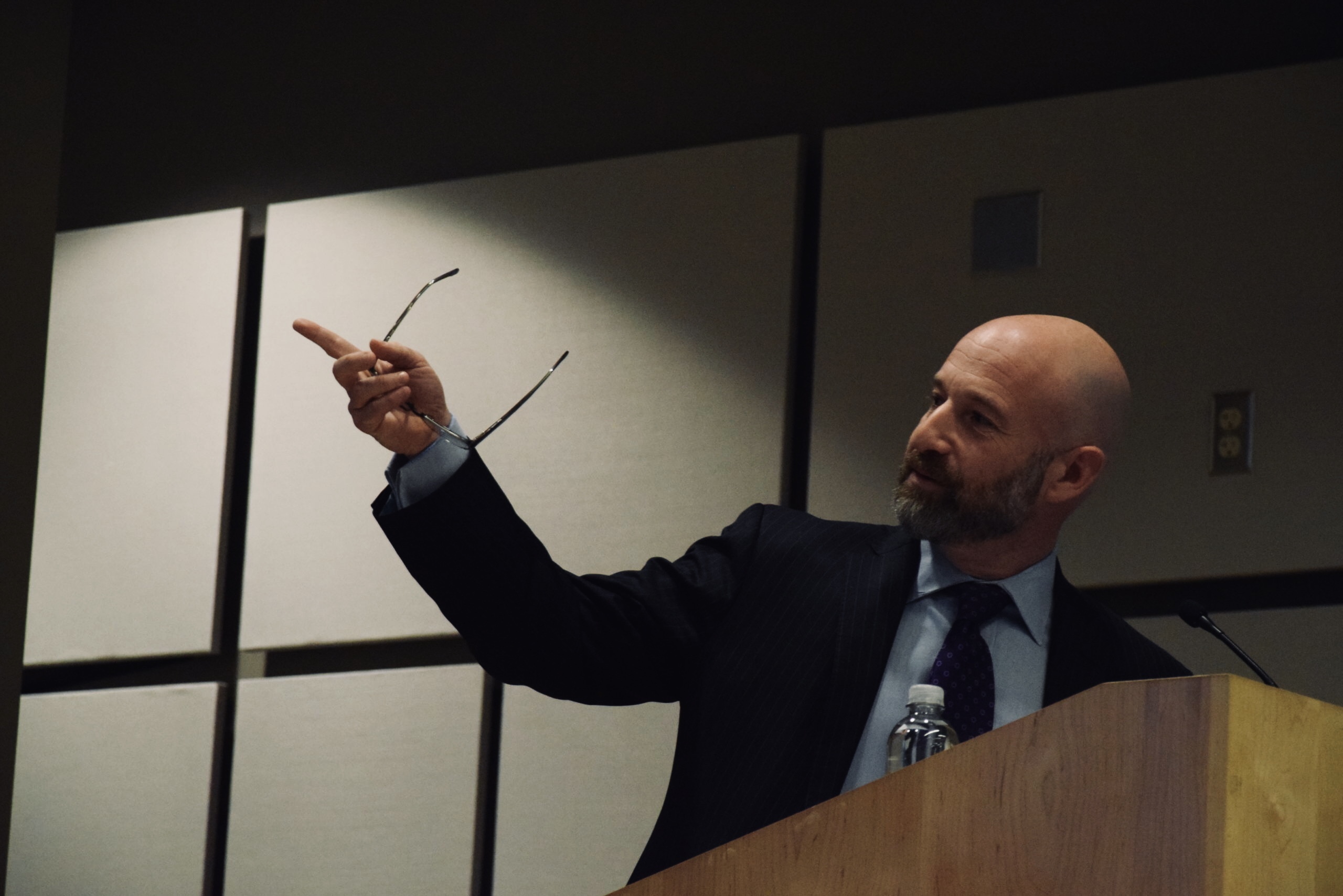
PART II: Dr. Hal Singer on How to Best Regulate Big Tech
This article is the second installment of a two-part interview. As American and European governments propose new rules to regulate the growing monopoly power of technology giants, Dr. Hal Singer, Managing Director of Econ One, joins GJIA to discuss the future of Big Tech. In this interview, he discusses the effects of monopolization in the digital space and how the government should go about regulating technology firms.
GJIA: In a recent article you authored on ProMarket, you discussed the idea of pre-distribution antitrust, where the government intervenes before an industry tips towards a monopoly. What metrics should the government use to determine where to intervene, and what sorts of measures could the government impose?
I think that we have this mess on our hands about how to deal with monopolies in these data-driven markets, whether it’s Facebook, Google, Amazon, or Apple. The question is: was there some sign ten years ago or fifteen years ago? I am not just talking about stopping acquisitions. Rather, was there a sign that these markets were tipping in the direction of a monopoly? Was there anything that we could have done as a government to help bolster some rival platforms to avert this outcome? We recognize now that once we allow the market to tip, particularly in data-driven markets, we have whole new entry barriers. Now the question is: how is the entrant ever going to overcome the advantage that the incumbent is able to enjoy? The lead just gets bigger and bigger every day as [the incumbents] are able to exploit this unique data set that is only available to them.
In this piece, I use Tesla as an example. I do not mean to pick on Tesla; I am a big Tesla fan, but I do think that they are running away with the electric vehicle prize. The way that I think so is when I look at battery life, and this is a very selective sample, Tesla’s battery on some models can go up to 400 or 500 miles on a charge. Porsche just came out with their first electric vehicle, and I think that the battery life is around 100 or 150 miles. As a consumer, you are looking at that, like “wow, that is a big difference. I love the way that the Porsche looks, but you know, how could I deal with that?” On top of that, Porsche lacks this nationwide footprint of supercharging stations whereas Tesla has one. Additionally, there is a great story in the New York Times about how Tesla exploits the data that they have on drivers every day. They are watching everything that we do. They make little tweaks to the battery, and they can see how those tweaks affect overheating or the range. This is a data set that is proprietary and unique to Tesla. So Tesla has the advantage, and it just keeps on getting better and better.
What I worry about is that the distance is never going to be made up. So in this piece, I suggested that the government can just wait around and do nothing, which is what we did with all prior data monopolists, and then try to solve it on the backend. Or, is there a modest intervention, a nudge, that would push us towards a competitive outcome? I pose the question: what if the government were to build a network of rival supercharging stations that were interoperable and open to all would-be entrants? Then they could turn these supercharging stations over to be operated by private entities, so long as those entities did not have any affiliation with any electric vehicle maker. That is just an idea that I had of a type of intervention (Marshall Steimbaum and I wrote it). We call it pre-distribution because the idea is that we are doing something on the frontend, rather than waiting for the market to tip to monopoly and do something on the backend.
GJIA: The European Union has proposed something similar to what you mentioned about forcing certain platforms to share data, such as Facebook or Google, to level the playing field. Do you think that data sharing could be applied to current tech giants to preserve competition?
Two things are necessary, not just data portability, but also data interoperability. To break that down, for those of us who are old enough to remember, we used to not have mobile number portability. You used to be trapped with your cellphone provider. The reason why you were trapped (also called lock-in effects) is that if you were to change your number, prior to mobile number portability being mandated by Congress, you had to tell all of your friends that your number was changing. People thought back in the pre-internet and pre-email days that this was really costly. So once Congress mandated mobile number portability, people started changing in droves. This put downward pressure on the price of cellphones and cellphone service; everyone kind of suggests this was a wonderful thing.
We have a harder problem in the modern platform monopolies in that not only do we need someone to be able to take their data with them, which is what mobile number portability did, but here we also need to be able to coordinate the move with others. When I went by myself, say, from AT&T to Sprint, I did not need to coordinate with my friends. It was just me going. When someone called my phone, and I was now using Sprint, it would ring. But the idea that I am going to break away from, say, Facebook, where my entire community is based, I have this extra coordination problem. That is why this interoperability becomes another requirement. It is a long way of saying I do not know if the problem is tractable, but it is much harder than the [previous] problem that we overcame in the mobile space.
One of the big things we talked about are movements to attack appropriation and self- preferencing. But another big movement and makes up a substantial part of the Report is that Congress wants to overrule ten-odd Supreme Court precedents in antitrust.
– Dr. Hal Singer
GJIA: What does the future of antitrust look like? Is it likely any of the measures called for in the House Report would ever be implemented?
One of the big things we talked about are movements to attack appropriation and self- preferencing. But another big movement and makes up a substantial part of the Report is that Congress wants to overrule ten-odd Supreme Court precedents in antitrust. These precedents have made it exceedingly difficult for plaintiffs to prevail in an antitrust case. In fact, it is so hard, that something on the order of ninety-eight percent of plaintiffs fail in these Section Two monopolization cases. It is a really, really low win rate. It is so low that you could imagine that a lot of plaintiffs and government regulatory agencies would say “why would we ever invest millions of dollars or more in an antitrust case, if our win rate is going to be two percent?” If Congress takes the House Subcommittee up on this task and overturns these ten pro-monopoly decisions that the Supreme Court has made over the last twenty years or so, I would expect that antitrust would be reinvigorated. You would see a bunch of cases that would not otherwise have been brought [to the courts] because the playing field was so hostile to players.
GJIA: Do you have any other recommendations for antitrust regulators or any lasting thoughts that you want to share?
I do think that the House Report is a nice template and a nice place to begin. They certainly picked upon my favorite idea, which concerns non-discrimination. One other area that I would push antitrust enforcers is to take an aggressive approach to worker welfare. We are starting to see this a bit; there are new cases that are being brought by private enforcers, at least with respect to no-poach agreements among the fast-food franchises. So, no-poach and non-competes are important areas.
But I fear that we are going to have a world where a defendant will be able to point to clear harms to workers that come about from some restraint that might be offset, in theory, by a benefit that the defendant splashes in the direction of consumers or end-users. This came up in a famous NCAA case where the defendants essentially said that they need to conspire to not pay students to play sports because surveys suggest that viewers attach a certain value to knowing that the students are out here not for the payment but for the love of the game. This was actually able to sway the court to allow the conspiracy to not pay the students. We need to do some cleaning up and maybe the proposed reversal of the Supreme Court’s Ohio v. American Express will get at it. We need to get to a point where if a plaintiff can show harm, whether it is to a worker or a merchant, and connect it causally to some kind of restraint, the inquiry should end. The idea that a defendant can point to some other third party and say that they benefit from the restraint and that their gains should be somehow used to offset the known harms, that to me, is going to be the next hot area of antitrust. I would hope it goes in one direction, which is no offsets, but I think your readers should stay tuned to see how that develops.
. . .
This transcript has been lightly edited for clarity and length.
Dr. Hal J. Singer is a managing director at Econ One Research, a senior fellow at the George Washington Institute of Public Policy, and an adjunct professor at Georgetown’s McDonough School of Business. He is a co-author of the e-book The Need for Speed: A New Framework for Telecommunications Policy for the 21st Century (Brookings Press 2013) and co-author of the book Broadband in Europe: How Brussels Can Wire the Information Society (Kluwer/Springer Press 2005). Dr. Singer has testified before Congress and has been widely cited by courts and regulatory agencies, including the Federal Communications Commission, the Federal Trade Commission, and the Department of Justice. His Twitter handle is @HalSinger.