
The View of the Coup from the Camp: Myanmar’s Emergent Trans-Ethnic Solidarity
The current protests also represent a rupture with past protest movements in Myanmar. The protesters’ spontaneous pivot in the first days of the mass uprising from wearing red, the color of Suu Kyi’s party, signifying a desire to return to the status quo of a nominal democratic process, to wearing black is notable. The switch to black clothing symbolizes a demand for the country to look beyond the current institutional arrangements that have promoted internal divisions. Consistent with this is the enormous banner hanging from the Yangon Student Union, declaring “There is no supreme savior.” Protestors are also demanding people look beyond the cult of personality politics, and those who seek only to bring Suu Kyi back to power will be forced to acknowledge the damage her regime has caused ethnic groups, activists, and the poor. Myanmar’s most marginalized have not lost sight of the unparalleled mendacity of the junta in retaking power after pledging to respect the constitutional process. The coup, then, delivers the final blow to the peace process with ethnic minorities, as no group will trust the junta to fulfill its pledges after the coup, an act which also creates certain political openings.
Conclusion: Toward Trans-ethnic Solidarity?
What does the future hold for Myanmar’s displaced peoples? Based on our observations of the past, it appears bleak. Thailand’s nine “temporary shelter areas,” or refugee camps, have been repatriating residents for the past decade, but they should now prepare themselves for a new onslaught of refugees from Myanmar. The Bangladeshi government expects the junta to keep its promise of repatriating refugees, but Bangladesh should instead plan on the more likely scenario: a state of effectively permanent displacement of Rohingya in their country.
However, evidence of emerging trans-ethnic solidarity between urban elites in Yangon and Rohingya refugees, between rebel leaders and labor movements, and between migrant laborers and protesters is promising. The coup is transforming multiple divergent groups into one counterpublic with an immediate goal, to undermine and crush the military dictatorship. The protestors have also united under a provocatively broader objective: to reimagine belonging and politics as becoming equitable for all ethnicities, religions, and classes in Myanmar.
To achieve this vision, the most immediate imperative is for civilians to “keep the streets,” which requires fighting a dual-front war, first against the junta and then against the factors undermining resistance, such as livelihood concerns and stoking of divisions between groups. Nascent campaigns to take local governance institutions and transform them into hubs of both resistance and survival, though the provision of resources to struggling community members, provides a chance to enact this budding inter-ethnic trans-class coalition. Doing so requires groups to resist calls to reinstall Suu Kyi and her brand of liberalism—which would risk dissolving the bonds forged in this space of exception, revealing that everyone was not in fact in the same “camp” together—and instead necessitates urban protesters to align themselves with exiled Rohingya, Karen, Tai, and other peoples who have endured crushing betrayals, yet view their own struggle in solidarity with all peoples in Myanmar.
. . .
Elliott Prasse-Freeman is an Assistant Professor at the National University of Singapore. His research is on contentious politics, ethnic conflict, and subaltern political thought in and around Myanmar.
Tani Sebro is an Assistant Professor of Global Politics at Humboldt State University and a Fulbright ASEAN U.S. Scholar. Her research interests span the subdisciplines of political ethnography, critical theory, migration, nationalism, aesthetics, and performance studies.
Image Credit: Htin Linn Aye (via Creative Commons)

The current protests also represent a rupture with past protest movements in Myanmar. The protesters’ spontaneous pivot in the first days of the mass uprising from wearing red, the color of Suu Kyi’s party, signifying a desire to return to the status quo of a nominal democratic process, to wearing black is notable. The switch to black clothing symbolizes a demand for the country to look beyond the current institutional arrangements that have promoted internal divisions. Consistent with this is the enormous banner hanging from the Yangon Student Union, declaring “There is no supreme savior.” Protestors are also demanding people look beyond the cult of personality politics, and those who seek only to bring Suu Kyi back to power will be forced to acknowledge the damage her regime has caused ethnic groups, activists, and the poor. Myanmar’s most marginalized have not lost sight of the unparalleled mendacity of the junta in retaking power after pledging to respect the constitutional process. The coup, then, delivers the final blow to the peace process with ethnic minorities, as no group will trust the junta to fulfill its pledges after the coup, an act which also creates certain political openings.
Conclusion: Toward Trans-ethnic Solidarity?
What does the future hold for Myanmar’s displaced peoples? Based on our observations of the past, it appears bleak. Thailand’s nine “temporary shelter areas,” or refugee camps, have been repatriating residents for the past decade, but they should now prepare themselves for a new onslaught of refugees from Myanmar. The Bangladeshi government expects the junta to keep its promise of repatriating refugees, but Bangladesh should instead plan on the more likely scenario: a state of effectively permanent displacement of Rohingya in their country.
However, evidence of emerging trans-ethnic solidarity between urban elites in Yangon and Rohingya refugees, between rebel leaders and labor movements, and between migrant laborers and protesters is promising. The coup is transforming multiple divergent groups into one counterpublic with an immediate goal, to undermine and crush the military dictatorship. The protestors have also united under a provocatively broader objective: to reimagine belonging and politics as becoming equitable for all ethnicities, religions, and classes in Myanmar.
To achieve this vision, the most immediate imperative is for civilians to “keep the streets,” which requires fighting a dual-front war, first against the junta and then against the factors undermining resistance, such as livelihood concerns and stoking of divisions between groups. Nascent campaigns to take local governance institutions and transform them into hubs of both resistance and survival, though the provision of resources to struggling community members, provides a chance to enact this budding inter-ethnic trans-class coalition. Doing so requires groups to resist calls to reinstall Suu Kyi and her brand of liberalism—which would risk dissolving the bonds forged in this space of exception, revealing that everyone was not in fact in the same “camp” together—and instead necessitates urban protesters to align themselves with exiled Rohingya, Karen, Tai, and other peoples who have endured crushing betrayals, yet view their own struggle in solidarity with all peoples in Myanmar.
. . .
Elliott Prasse-Freeman is an Assistant Professor at the National University of Singapore. His research is on contentious politics, ethnic conflict, and subaltern political thought in and around Myanmar.
Tani Sebro is an Assistant Professor of Global Politics at Humboldt State University and a Fulbright ASEAN U.S. Scholar. Her research interests span the subdisciplines of political ethnography, critical theory, migration, nationalism, aesthetics, and performance studies.
Image Credit: Htin Linn Aye (via Creative Commons)
Dust continues to settle on the shocking February 1 military coup that delivered the death knell to Myanmar’s already moribund democratic transition. The world has watched transfixed as mass protests congealed in Myanmar’s urban areas, centered around the Civil Disobedience Movement (CDM), a spontaneously emergent social movement against the junta. Yet, as protesters continue banging loudly on pots and pans in the cities, a disquiet is looming for Myanmar’s ethnic minority groups, especially the 700,000 Rohingya in Bangladesh’s Cox’s Bazar refugee camp and the approximately 100,000 Karen, Tai (Shan), Kachin, and other ethnic groups encamped along the Thai-Myanmar border.
For many of Myanmar’s non-Burman groups, life under the auspices of democratic transition never improved but rather precipitously worsened, in some cases bringing genocide, and in others intensifying dispossession and protracting civil war. Since the return to junta rule, how are Myanmar’s displaced peoples reacting to the coup, and more importantly, what hopes and fears do they harbor for the future of Myanmar?
Certainly, there is fear that the military’s return to power, without any democratic transition or peace process to constrain it, will exacerbate ethnic minorities’ misery. Yet the collapse of the military-civilian hybrid system in Myanmar has also left a sense of opportunity, namely, a sense that the country should not restore rule by mainstream liberals who would sacrifice the needs of ethnic peoples, peasants, and workers, for the sake of Burman bourgeois supremacy and enrichment. Thus, a new horizon of trans-ethnic and pro-poor solidarity is emerging in the country, and it may hold the key to a future when power is finally claimed by all the peoples of Myanmar.
The Vexing Coup
Prior to the February 1 coup, Myanmar’s democratic transition appears to have been headed exactly where the Tatmadaw, Myanmar’s Armed Forces, desired. Military elites both continued accumulating capital by selling-off of the country’s natural resources and consolidated power over various perceived enemies—from armed ethnic groups to the persecuted Rohingya—while allowing civilian leaders such as Aung San Suu Kyi to deal with the daily challenges of governing and the international opprobrium over the Rohingya genocide. Hence the shock: why would the military want to upend this seemingly beneficial status quo?
While the military cites election fraud as the official reason for the coup, as other struggling democracies around the globe have also recently illustrated, these claims are unsubstantiated. Instead, many see the coup as channeling the political ambitions of the military’s Commander in Chief, Min Aung Hlaing. However, given his responsibility for a vast organization of capital accumulation and violence, reducing the coup to his personal whims is difficult to prove. Burmese politics have long been reduced to palace intrigue and individual scheming. Yet even if individual ambitions are significant, the senior generals’ interests are circumscribed by other factors, including the desire for increased control of natural resources and an appearance of power in which losses to Suu Kyi, coupled with progress toward national reconciliation with ethnic groups that ultimately sidelines the military junta, are too diminishing to tolerate.
Betrayal of Myanmar’s Ethnic Peoples
Regardless of the junta’s motives, many Burmese are understandably devastated. Despite the democratic transition’s manifest failures, people still harbored hopes that the structural conditions of diarchic rule could be overcome through democracy. With the coup, it appears that the nation’s political situation has reset to where it was a decade ago.
Except, however, a genocide has occurred since then. In the “clearance operations” of September 2017, more than 700,000 of the mostly-Muslim Rohingya minority were driven over Myanmar’s northwest border into Bangladesh. An estimated 24,000 perished at the hands of marauding soldiers who raped with impunity as they burned hundreds of villages. When the country was taken before the International Court of Justice to face accusations of genocide, Suu Kyi shamelessly defended the very junta that has now imprisoned her again. The irony here is plain. Many Rohingya, viewing the coup from refugee camps in Bangladesh, have interpreted the event as comeuppance for a coward who sold her soul for power, which she has now lost. As a Rohingya refugee commented:
“Aung San Suu Kyi has been detained by genocidal military she shamelessly defended. She betrayed Rohingya and the world […] I hope now she can understand the pain of being betrayed.”
Moreover, many refugees and other ethnic minorities worry that their situation will only worsen following the coup. Saw Kwe Htoo Win, vice-chairperson of the Karen National Union, summarized this position: “whether the NLD is in power or the military takes power… [we] will continue to suffer.” Indeed, as a Tai (Shan) former refugee camp resident tells us, the coup will inevitably “bring more refugees.” A research collaborator of ours in Shan State imparts, “My worry is if the coup forces people to leave the country there is no way to flee because COVID-19 is affecting all neighbor countries too.” This fear of continued hardship and repression is particularly acute given escalating violence against civilians coupled with the recent displacement of 1,000 civilians in Karen State following hostilities with the Tatmadaw.
But despite these fears, some ethnic minorities are using the coup as an opportunity to forge a politics of trans-ethnic solidarity. Rohingya poet Mayyu Ali has made such calls: “The people in Myanmar didn’t feel sympathy for us when we were suffering. But I feel sympathy for them.” These transethnic appeals are strategic efforts to foster solidarity across groups in a common struggle with other Burmese subjects against a shared enemy, the military. In these appeals, the Rohingya use themselves as a cautionary tale regarding the potential violence to come when Myanmar’s anti-dictatorship activists and masses face head-on a junta that detests the aesthetics of what it calls “undisciplined democracy.” In so doing, the Rohingya show Myanmar’s other peoples that they are all subject to the junta’s extra-judicial state of exception—to invoke philosopher Giorgio Agamben, everyone right now feels they are in “the camp.”
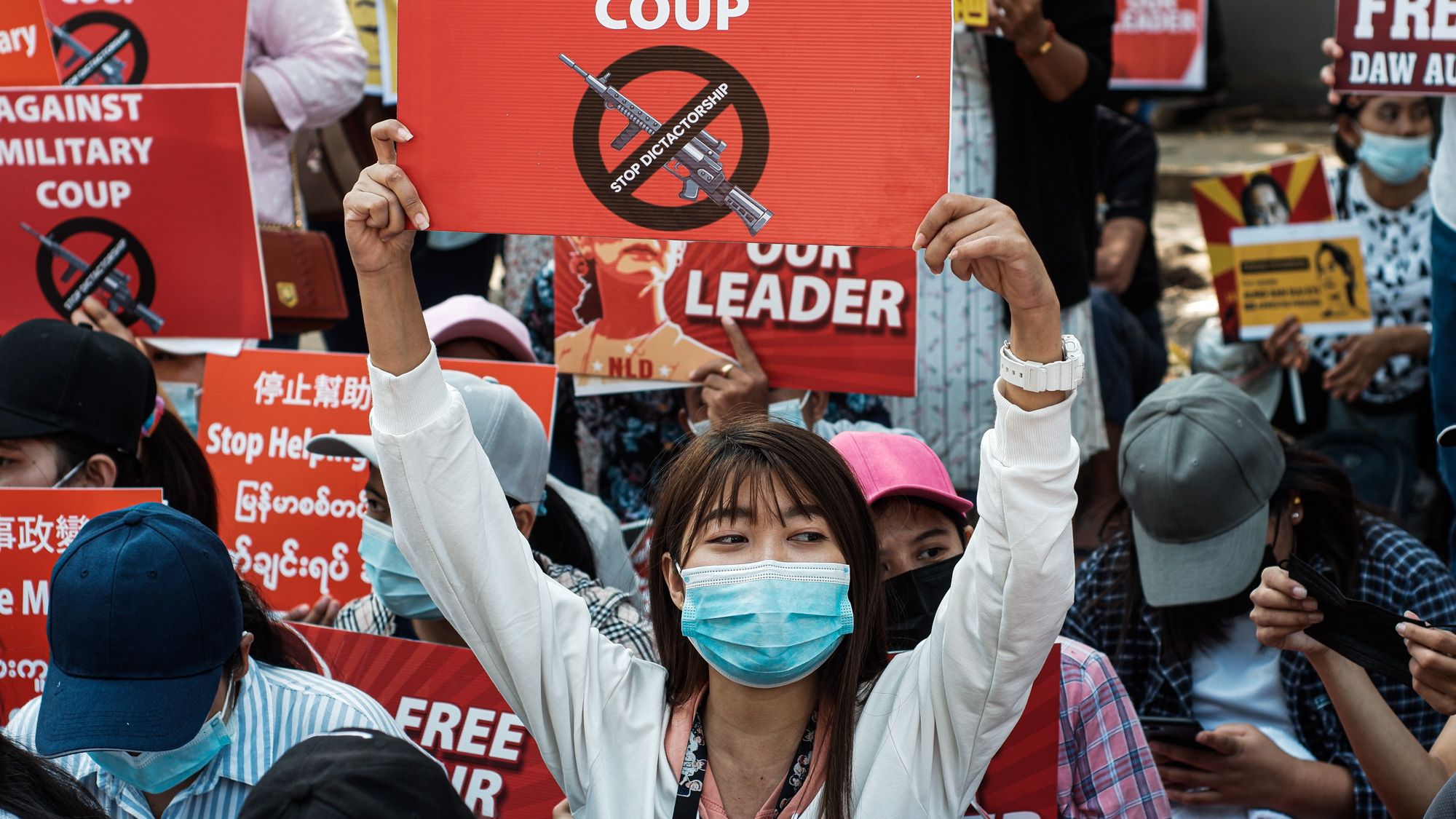
Hence, in a perverse sense, the coup may actually improve longer-term prospects for the Rohingya, or at least provide a shred of hope that did not appear to exist just days before the coup. At that time, Aung San Suu Kyi and the military walked in lockstep over the dead, Buddhist monks brayed for Rohingya blood, and the public mostly endorsed the genocide. Now, Rohingya openly self-identify as they protest on the streets of Yangon, while more and more non-Rohingya stand in solidarity with them, holding signs declaring their remorse. The circulation of inclusionary protest signs on Facebook points to the possibility of a more capacious political community being imagined in Myanmar.
The current protests also represent a rupture with past protest movements in Myanmar. The protesters’ spontaneous pivot in the first days of the mass uprising from wearing red, the color of Suu Kyi’s party, signifying a desire to return to the status quo of a nominal democratic process, to wearing black is notable. The switch to black clothing symbolizes a demand for the country to look beyond the current institutional arrangements that have promoted internal divisions. Consistent with this is the enormous banner hanging from the Yangon Student Union, declaring “There is no supreme savior.” Protestors are also demanding people look beyond the cult of personality politics, and those who seek only to bring Suu Kyi back to power will be forced to acknowledge the damage her regime has caused ethnic groups, activists, and the poor. Myanmar’s most marginalized have not lost sight of the unparalleled mendacity of the junta in retaking power after pledging to respect the constitutional process. The coup, then, delivers the final blow to the peace process with ethnic minorities, as no group will trust the junta to fulfill its pledges after the coup, an act which also creates certain political openings.
Conclusion: Toward Trans-ethnic Solidarity?
What does the future hold for Myanmar’s displaced peoples? Based on our observations of the past, it appears bleak. Thailand’s nine “temporary shelter areas,” or refugee camps, have been repatriating residents for the past decade, but they should now prepare themselves for a new onslaught of refugees from Myanmar. The Bangladeshi government expects the junta to keep its promise of repatriating refugees, but Bangladesh should instead plan on the more likely scenario: a state of effectively permanent displacement of Rohingya in their country.
However, evidence of emerging trans-ethnic solidarity between urban elites in Yangon and Rohingya refugees, between rebel leaders and labor movements, and between migrant laborers and protesters is promising. The coup is transforming multiple divergent groups into one counterpublic with an immediate goal, to undermine and crush the military dictatorship. The protestors have also united under a provocatively broader objective: to reimagine belonging and politics as becoming equitable for all ethnicities, religions, and classes in Myanmar.
To achieve this vision, the most immediate imperative is for civilians to “keep the streets,” which requires fighting a dual-front war, first against the junta and then against the factors undermining resistance, such as livelihood concerns and stoking of divisions between groups. Nascent campaigns to take local governance institutions and transform them into hubs of both resistance and survival, though the provision of resources to struggling community members, provides a chance to enact this budding inter-ethnic trans-class coalition. Doing so requires groups to resist calls to reinstall Suu Kyi and her brand of liberalism—which would risk dissolving the bonds forged in this space of exception, revealing that everyone was not in fact in the same “camp” together—and instead necessitates urban protesters to align themselves with exiled Rohingya, Karen, Tai, and other peoples who have endured crushing betrayals, yet view their own struggle in solidarity with all peoples in Myanmar.
. . .
Elliott Prasse-Freeman is an Assistant Professor at the National University of Singapore. His research is on contentious politics, ethnic conflict, and subaltern political thought in and around Myanmar.
Tani Sebro is an Assistant Professor of Global Politics at Humboldt State University and a Fulbright ASEAN U.S. Scholar. Her research interests span the subdisciplines of political ethnography, critical theory, migration, nationalism, aesthetics, and performance studies.
Image Credit: Htin Linn Aye (via Creative Commons)